
In short: A page can rank in a conventional search result while a brand remains absent from an AI answer. Tracking the questions people ask, the brands named in responses, and the pages cited gives a more useful view of that gap.
Disclosure: This article contains Semrush affiliate links. Dijipedya may receive a commission if you sign up through them, at no extra cost to you. The editorial analysis and limitations below are our own.
Table of Contents
- Start with questions, not a single brand search
- What Semrush Prompt Tracking measures
- A practical five-step audit
- Read the metrics carefully
- Choose prompts that reveal a real decision
- What a citation gap actually tells you
- A simple reporting table for your team
- Who should pay for it?
- Frequently asked questions
Start with questions, not a single brand search
Checking whether an AI assistant knows your company name is a weak test. A buyer is more likely to ask “Which tools help a small team audit its website?” or “What is a good alternative for tracking AI search visibility?” Build a small set of questions that represent discovery, comparison and purchase intent. Record the exact wording, market and language so the comparison remains meaningful over time.
For each question, distinguish three observations: a brand mention in the answer, a citation to your domain, and a citation to somebody else’s page that discusses your category. They are related, but they do not measure the same thing. A mention is not automatically a click or a sale.
What Semrush Prompt Tracking measures
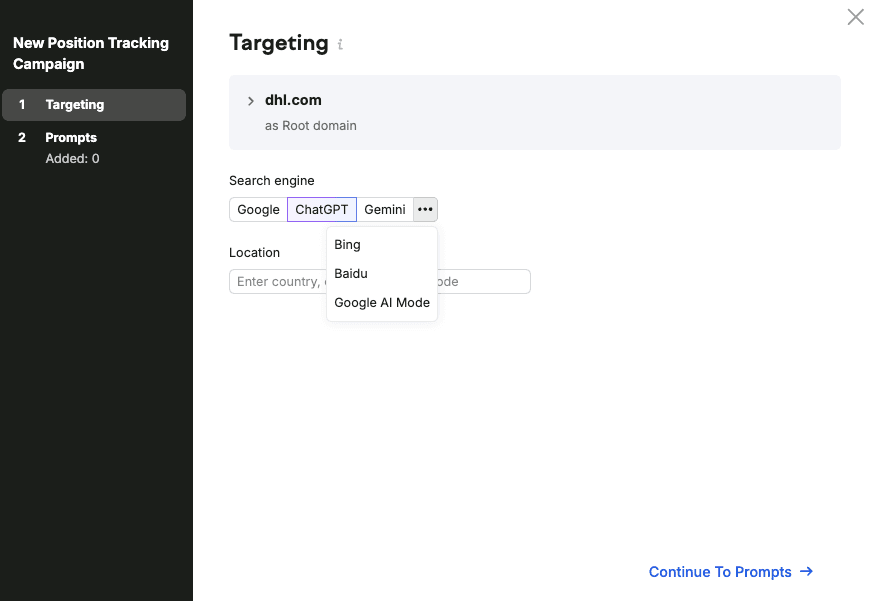
Semrush AI Visibility Toolkit’s Prompt Tracking lets subscribers monitor a chosen set of prompts in ChatGPT Search, Google AI Mode and Gemini. Its reports show daily visibility, mentions, average position and cited sources for tracked questions. You can compare these results with conventional rankings and examine snapshots of the actual answer. This is a sampled measurement of selected prompts, not a census of every AI response a user might see.
A practical five-step audit
- Choose 10–20 decision questions. Include broad category questions, specific comparisons and questions about a problem your product solves. Avoid writing only prompts that already contain your brand name.
- Fix the market and language. Geography changes results. In Prompt Tracking, select the available location and language before adding the queries.
- Establish a baseline. Record which prompts mention the brand, which cite the site and which cite a competitor or independent source. Look at answer snapshots to understand context, not just a summary score.
- Prioritize a gap. A missing mention on a high-intent comparison question can be more useful than a strong score on a low-intent question. Check whether a clear product page, explanatory guide or independent coverage is missing.
- Review changes over time. Track the same prompts and settings, then annotate site edits and external coverage. A visibility change alone does not prove that one edit caused it.
Read the metrics carefully
Semrush defines mentions as answers where the selected brand name appears. Its Sources report lists domains and URLs cited for tracked prompts, including your own pages. Average position in an AI answer is a tool-specific representation of answer or citation placement; it should not be interpreted as an ordinary Google ranking. The documentation also says estimated traffic is not available for these AI tracking engines and only desktop searches are currently supported.
For a broader discovery view, Visibility Overview includes mentions, citations, cited pages, topic opportunities and a breakdown by platform. Semrush says this report draws on a database of more than 317 million AI queries and refreshes data daily on a rolling basis. A large reference database is useful for benchmarking, but it still does not reveal every personal response seen by every user.
Choose prompts that reveal a real decision
A useful prompt set should cover the path from discovery to choice. For a website analytics product, a discovery prompt might ask which tools show a brand’s appearance in AI answers. A comparison prompt might ask how two categories of tools differ. A decision prompt might ask which option fits a small team. Write down why each question matters before you track it; a long list of vanity prompts creates more charts without more insight.
Keep a control group of prompts that do not mention your brand. If you ask the system directly about your company, you are testing recognition of the name. If you ask about the category without naming the company, you are testing whether the brand appears when a potential customer needs it.
What a citation gap actually tells you
If a competitor appears in a generated answer and your brand does not, resist assuming that one extra keyword will fix the problem. Inspect the answer and cited sources first. Is the competing brand named because of a comparison page, an independent review, documentation, or a product page? Does your own page answer the same question with evidence? The Visibility Overview report’s topic and source opportunities can help you find those differences.
Sometimes the right action is to update a clear product explanation; sometimes it is to publish a useful benchmark or earn independent coverage. Keep the action tied to the source pattern you observed. After publishing, monitor the same prompts for a sustained change, and treat that change as an observation rather than proof of causation.
A simple reporting table for your team
For each tracked question, log its intent, selected market, the brand mentioned, whether your domain was cited, which outside sources were cited, the date, and a proposed editorial action. Review the table alongside ordinary search performance. That comparison prevents a high AI visibility score from hiding an absence on the few questions that actually matter to customers.
Who should pay for it?
The method is most useful for a team that can act on the gaps it finds. If you only need a few spot checks, a manual spreadsheet can be a sensible starting point. If you need daily prompt monitoring, competitor comparisons and cited-source reports, the AI Visibility Toolkit puts those observations in one workflow. Semrush currently lists the standalone toolkit at $99 per month and says it has no free trial; check the current checkout terms before subscribing. Other Semrush products may have different trials, so do not assume a seven-day trial applies to this toolkit.
Frequently asked questions
Is a brand mention the same as a citation?
No. A brand can be named without a link to its website, and a site can be cited without the brand being recommended. Record both separately.
Can a first-place Google ranking guarantee AI visibility?
No. Traditional rankings and AI-generated answers are different views. Compare both for the same topic rather than treating one as a substitute for the other.
Does Prompt Tracking show traffic from AI?
Not directly. Semrush’s documentation says estimated traffic is not available for the AI tracking engines. Use your own analytics for visits and conversions.
Is there a free trial for the AI Visibility Toolkit?
Semrush’s current knowledge base says the standalone AI Visibility Toolkit has no free trial. Check the current plan terms before subscribing.
See how AI answers mention your brand
Compare tracked prompts, mentions and cited sources in the Semrush AI Visibility Toolkit.
Affiliate link. Dijipedya may earn a commission at no additional cost to you.
Get Dijipedya’s guides on AI tools and visibility straight to your inbox.
More From Dijipedya
Sources (accessed September 29, 2026): Semrush, Prompt Tracking; Semrush, Visibility Overview Report; Semrush, AI Visibility Toolkit.