Link builders have a new question to answer. Clients no longer ask only “What is the DR of that site?” They ask “Did that placement get us cited in ChatGPT or Google’s AI answers?” Most teams cannot answer it yet. A new industry survey shows 79.3% of SEO leaders have been asked to make AI citations a KPI, but only 21.6% track citations as a core KPI.
This guide looks at what the data says about backlinks and AI citations, why domain-level metrics are losing their grip on link vetting, and how to build a simple before-and-after measurement process that turns “we believe the link worked” into a report.
Disclosure: This article is sponsored by Semrush as part of a paid partnership and contains Semrush affiliate links. Dijipedya may earn a commission if you sign up, at no extra cost to you. The analysis and opinions are our own.
Contents
- What 116 SEO leaders just said about links
- Why backlinks and AI citations are connected
- DR, Authority Score and what to vet instead
- How to measure whether a link earned AI citations
- A placement-to-citation log you can copy
- What to show leadership
- Limits and honest caveats
- Tools and pricing
- Frequently asked questions
What 116 SEO leaders just said about links
uSERP’s State of Backlinks for SEO report, published in late September 2026, surveyed 116 SEO professionals, 47.4% of them at Director or Head of SEO level and 56.9% with more than ten years in the field. The headline numbers:
| Finding | Share of respondents |
|---|---|
| Believe backlinks influence whether AI engines cite their brand | 81.9% |
| Have seen a backlink lead to an AI citation, with before-and-after evidence | 46.6% |
| Believe it happened but cannot prove it | 25.0% |
| Asked by a client or leader to make AI citations a KPI (past 12 months) | 79.3% |
| Track AI citations as a core link-building KPI | 21.6% |
| Track AI citations only informally | 51.7% |
| Would keep building links even if Google stopped using them for rankings | 87.1% |
| Call topical relevance the deciding factor for a link | 58.6% |
| Call Domain Rating or Domain Authority the deciding factor | 11.2% |
Two gaps jump out. The first is a measurement gap of almost 58 points between the leaders being asked for citation KPIs and those who track them formally. The second is a vetting shift: Domain Rating finished last among deciding factors, behind topical relevance (58.6%), real organic traffic (13.8%) and even how often AI engines cite a domain (12.1%). Digital PR was named the tactic with the strongest results by 53.4%, while guest posting showed the biggest gap between use and effectiveness for 40.5%.
Why backlinks and AI citations are connected
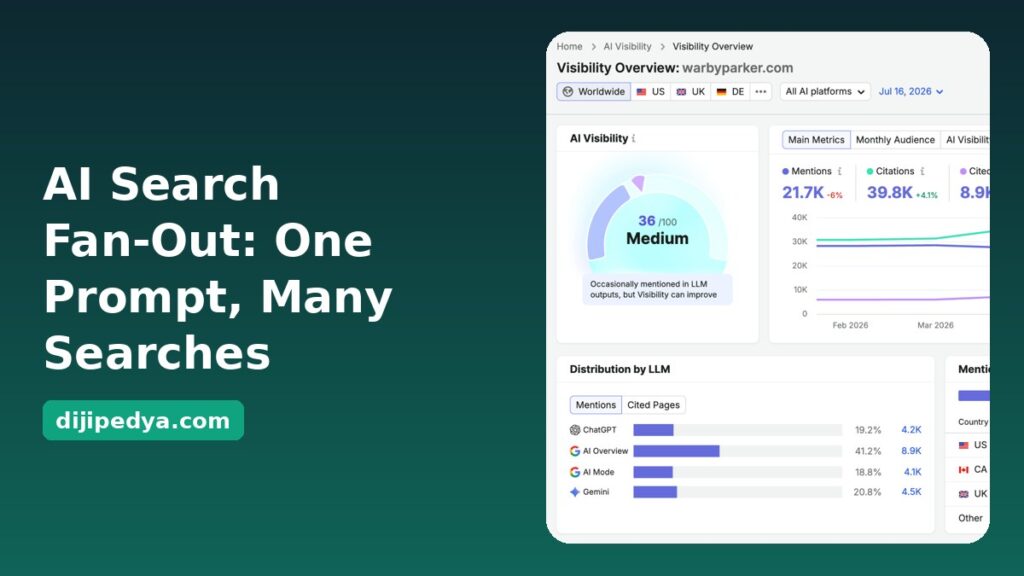
AI answers are built from retrieved web pages. Systems such as Google AI Mode and ChatGPT search run several sub-queries for one prompt, read the pages that rank for them and cite some of those pages. That gives links two routes to influence AI visibility:
- Indirectly, through rankings. Links still help pages rank, and pages that rank for the sub-queries are the ones an assistant reads. We explain this retrieval step in our guide to AI search fan-out.
- Directly, through mentions on retrieved pages. A detailed brand mention on a third-party review or comparison page that the assistant reads can lead to the brand being named, even if the link itself passes little ranking value.
This is why a placement on a relevant page that ranks and gets read can be worth more than a link from a high-DR site with no organic traffic. It is also why AI citation tracking belongs in link reporting: the outcome you care about may be a mention or a citation, not a ranking change.
DR, Authority Score and what to vet instead
Domain-level scores such as Ahrefs’ Domain Rating, Moz’s Domain Authority and Semrush’s Authority Score are still useful as a floor. Semrush’s Authority Score runs from 1 to 100 and combines link power, organic traffic and natural-profile (spam) signals, which makes it harder to inflate with links alone than a pure link metric. A “good” Authority Score is relative: compare it with the sites that already rank in your niche rather than chasing a fixed number.
But a domain score is not a vetting process. For each prospect, check:
- Topical relevance of the exact page, not just the domain.
- Real organic traffic to the domain and, ideally, the page, using Backlink Analytics and Domain Overview.
- Spam and link-scheme signals, such as sitewide link patterns and sudden link spikes; Backlink Audit flags toxic patterns in your own profile so you can spot placements that are hurting rather than helping.
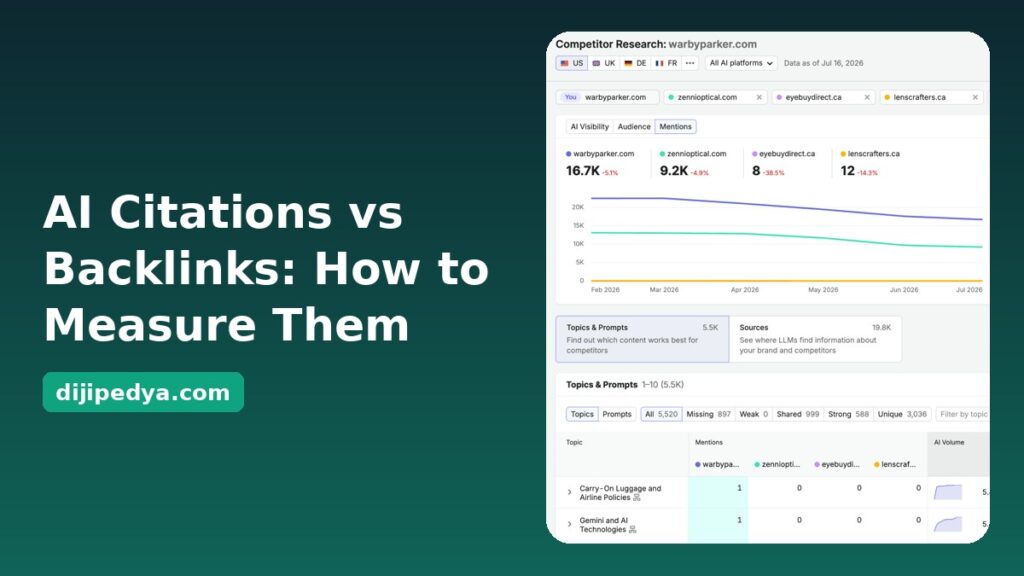
- AI citation presence: does the domain already appear as a source in AI answers for your topic? Competitor Research in the AI Visibility Toolkit shows which sources AI answers cite for prompts where your competitors appear.
How to measure whether a link earned AI citations
No tool can prove that one link caused one citation; AI answers vary between runs and many factors change at once. What you can produce is consistent before-and-after evidence for a defined set of prompts. Here is a five-step process.
1Define the prompts that matter
For each campaign, choose 10 to 25 prompts a buyer would ask, covering discovery, comparison and purchase questions. Use Prompt Research to check that they reflect real AI demand. Record wording, language and location.
2Record a baseline before the placement goes live
Add the prompts to Prompt Tracking, which checks visibility and position daily in ChatGPT and Google AI Mode. Note whether your brand is mentioned, whether your domain is cited, and which third-party pages are cited instead. Keep at least one or two weeks of data before the link goes live.
3Log every placement with its target prompts
For each link, log the URL, publish date, anchor or mention type (full feature, list entry, footer link), the referring page’s organic traffic and the prompts it is meant to influence.
4Check whether the referring page itself gets cited
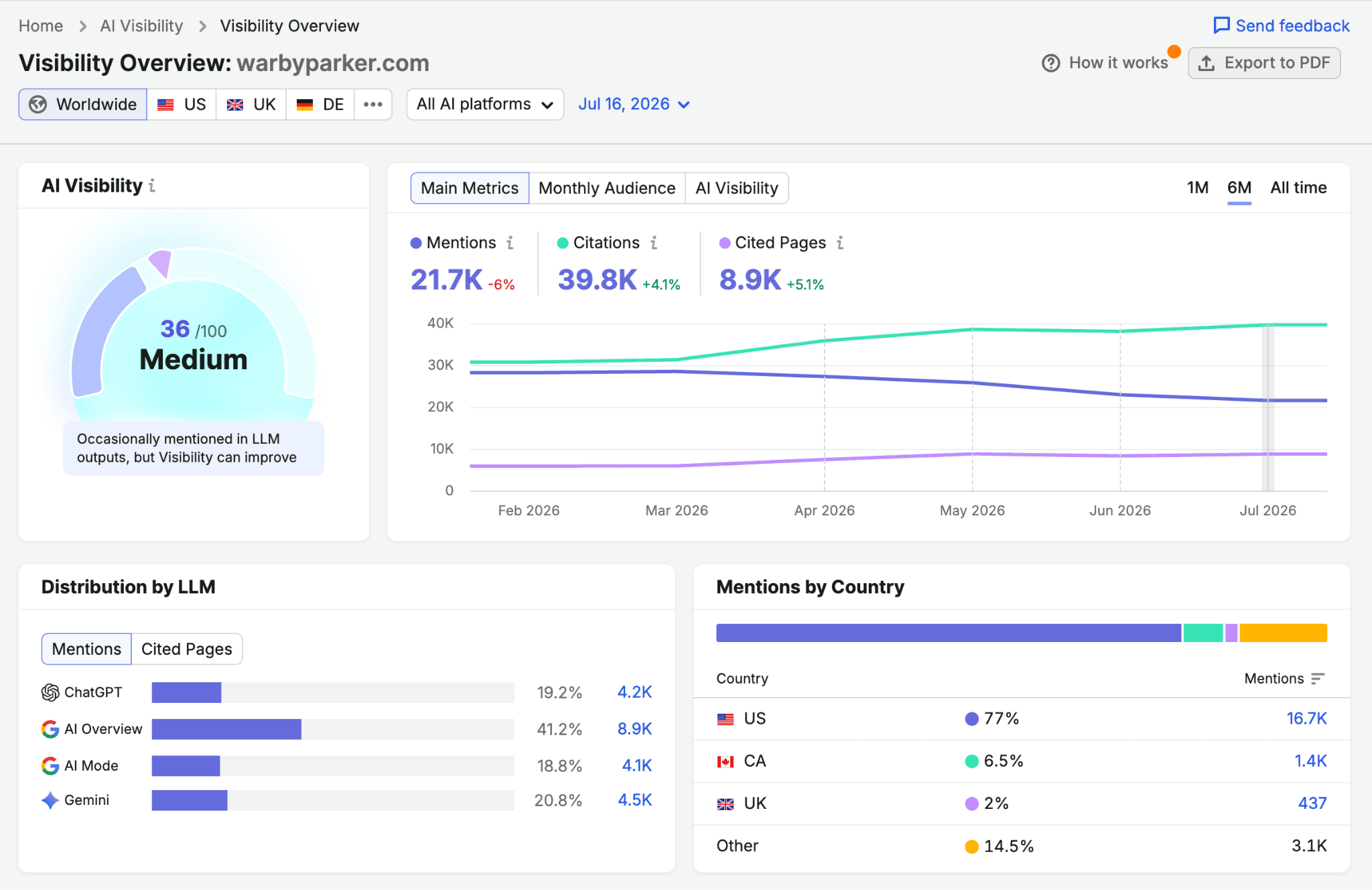
The fastest signal is not your own citation but the referring page appearing as a source. Watch the cited sources in Visibility Overview and Competitor Research. If the page that mentions you starts being cited for your prompts, your brand is now inside the material the assistant reads.
5Compare 30 and 60 days later
Compare prompt visibility, mentions and citations with the baseline, alongside classic rankings from Position Tracking. Use Brand Performance to see whether share of voice and sentiment changed, especially for full-feature mentions versus simple link insertions.
A placement-to-citation log you can copy
This is the structure we suggest for a shared sheet. The rows below are illustrative examples of how to fill it in, not real results.
| Placement | Type | Referring page traffic | Target prompts | Baseline (mentions / citations) | Day 30 | Day 60 | Referring page cited? |
|---|---|---|---|---|---|---|---|
| Industry comparison article | Full feature with link | Ranks and gets traffic | 5 | 1 / 0 | 3 / 1 | 4 / 2 | Yes |
| Niche directory listing | List entry | Low | 5 | 1 / 0 | 1 / 0 | 1 / 0 | No |
| Guest post on a general blog | Footer link | None measurable | 5 | 1 / 0 | 1 / 0 | 1 / 0 | No |
Kept for a quarter, a log like this answers the questions leadership is asking: which types of placements correlate with mentions and citations, for which prompts, and how fast.
What to show leadership
- Prompt visibility trend for the campaign prompts, against two or three competitors.
- Citation and mention counts as trends, never as a single-day number.
- Referring pages that became AI sources, with dates.
- Link quality mix: share of placements on relevant pages with real traffic, rather than average DR.
- Classic rankings for the pages the links point to, since rankings feed retrieval.
This replaces the DR-only slide many agencies still use, and it gives a renewal conversation something concrete: here is the placement, here is the prompt, here is the citation.
Limits and honest caveats
- Correlation, not proof. Content updates, competitor changes and model updates happen at the same time as your links. Present results as evidence, not causation.
- Volatility. AI citations change between runs and after model updates, which is why daily tracking and trend lines matter more than snapshots.
- Data are estimates. How accurate is Semrush? Like every third-party SEO tool, traffic and authority figures are modelled estimates. They are good for comparing sites and spotting trends; confirm your own traffic in your analytics.
- Coverage limits. Prompt Tracking currently monitors ChatGPT and Google AI Mode; other assistants need separate checks.
Tools and pricing
Link vetting tools such as Backlink Analytics and Backlink Audit are part of the Semrush SEO Toolkit. Citation and prompt tracking is in the AI Visibility Toolkit, which costs $99 per month and has no free trial as a standalone product, according to Semrush. Semrush One combines both toolkits, and Semrush offers a free 7-day trial on its main plans, which is enough to set up a baseline for a campaign. Check current terms at checkout. Our AI Visibility Toolkit review covers the features in more depth.
Frequently asked questions
Do backlinks help you get cited by AI?
Most SEO leaders think so: 81.9% in uSERP’s 2026 survey believe backlinks influence AI citations, and 46.6% have seen before-and-after evidence. Links help pages rank for the sub-queries AI systems search, and mentions on retrieved pages can lead to brand citations.
How do I track AI citations from link building?
Pick a fixed set of prompts, record a baseline in an AI visibility tool such as Semrush Prompt Tracking, log each placement with its target prompts and compare mentions, citations and cited sources after 30 and 60 days.
Is Domain Rating still useful for vetting links?
As a floor, yes. As a deciding factor, only 11.2% of SEO leaders in the 2026 uSERP survey still use it; most prioritise topical relevance and real organic traffic.
What is a good Authority Score on Semrush?
Authority Score runs from 1 to 100 and is comparative. Compare a site with the domains that already rank for your topics instead of aiming for a fixed number.
How accurate is Semrush data for link vetting?
Semrush figures are modelled estimates, as with any third-party SEO tool. They are reliable for comparison and trends; confirm exact traffic with the site’s own analytics where possible.
Is there a free trial for the AI Visibility Toolkit?
The standalone AI Visibility Toolkit has no free trial, according to Semrush. Semrush’s main plans offer a 7-day free trial.
Turn link placements into citation evidence
Track prompts, mentions and cited sources daily with the Semrush AI Visibility Toolkit and see which placements show up in AI answers.
Sponsored. Affiliate link: Dijipedya may earn a commission at no extra cost to you.
Get Dijipedya’s guides on AI search and visibility in your inbox.
Related guides on Dijipedya
Sources: uSERP, The State of Backlinks for SEO (published 26 September 2026); Semrush Knowledge Base, AI Visibility Toolkit; Semrush Knowledge Base, Authority Score; Google, AI Mode announcement (May 2025).