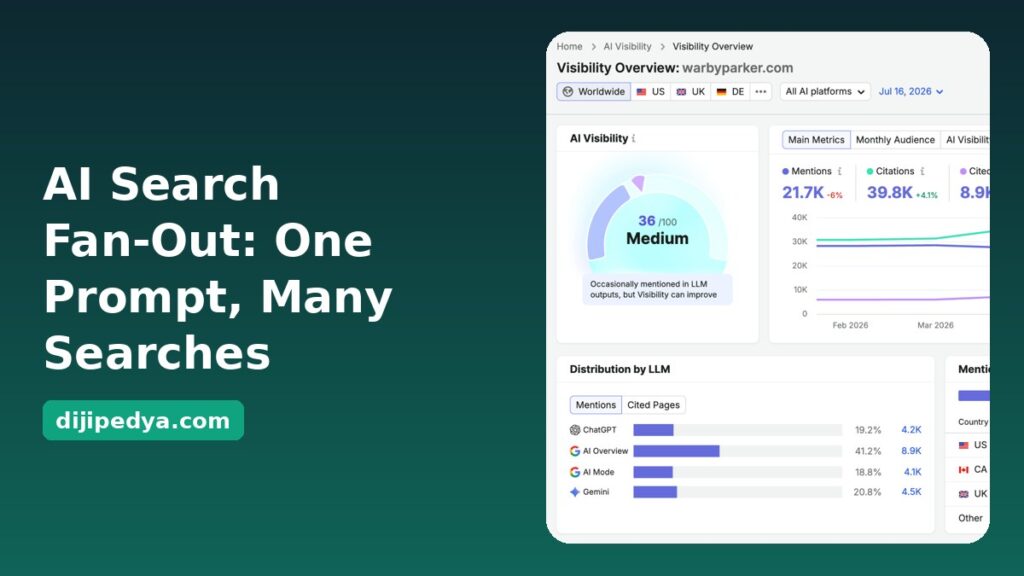
Ask an AI assistant “How do I create a website for my small business?” and it does not run one search. It quietly splits the question into several narrower ones, such as what a website costs, whether Wix or Squarespace is free, and how a new site gets onto Google, then reads the pages that answer those smaller questions and writes one reply. This is called query fan-out, and it changes what it means to be visible in AI search.
If your content only targets the headline question, you are competing for one of the searches behind the answer and missing the rest. This guide explains how fan-out works, what recent research says about it, and how to map and measure the hidden questions behind your buyers’ prompts, using a real keyword set from Semrush as a worked example.
Disclosure: This article is sponsored by Semrush as part of a paid partnership and contains Semrush affiliate links. Dijipedya may earn a commission if you sign up, at no extra cost to you. The analysis and opinions are our own.
Contents
- What query fan-out actually is
- What the research shows so far
- Why keyword and citation tracking miss it
- Case study: one small-business prompt, mapped
- A six-step fan-out coverage workflow in Semrush
- KPIs to report instead of a single citation count
- Common mistakes
- Which Semrush plan you need
- Frequently asked questions
What query fan-out actually is
Query fan-out is the step where an AI search system rewrites one prompt into several sub-queries, runs them in parallel and combines what it finds. Google described this openly when it launched AI Mode in May 2025: Search breaks a question into subtopics and issues many queries at once, and its Deep Search mode can run hundreds of searches for a single research request.
For a brand, the practical consequence is simple. The answer a buyer reads is assembled from pages that ranked for the sub-queries, not only for the original prompt. A comparison prompt such as “Wix vs Squarespace vs a hosted WordPress site” may trigger hidden searches on price, free plans, templates, SEO features and support. Each of those is a separate chance to be retrieved, quoted or cited, or to be left out.
What the research shows so far
- Google is making fan-out cheaper to run. In September 2026 Google Research published a framework called Retrieve-for-Train Diffusion (R4T). Search Engine Journal’s coverage reports a 53.9 million parameter model that generates sub-queries in one parallel pass, 12 to 20 times faster than step-by-step generation. Google has not said whether it runs in Search, but the direction is clear: more sub-queries, generated faster and at lower cost.
- ChatGPT’s sub-queries are getting longer. An analysis of more than 20 million ChatGPT fan-out queries by Peec AI found the average fan-out roughly doubled in length, from about 6 words in October 2025 to about 12 words in January 2026, while the number of fan-outs per prompt stayed at roughly 2.3 to 2.8 across five countries.
- Many sub-queries look nothing like human searches. In AirOps’ recap of Nectiv’s research on more than 60,000 AI-generated searches, Chris Long reported that reviews were the most common fan-out pattern for product, software and local queries, and that many sub-queries have no measurable search volume in traditional tools.
Taken together: fan-out queries are longer and more specific than the prompt, they lean towards evaluative questions such as reviews, pricing and comparisons, and they increasingly run in parallel. Content that only addresses a broad topic has fewer ways to be picked up.
Why keyword and citation tracking miss it
Most SEO reporting still answers two questions: where does the page rank for a keyword, and was the domain cited in the AI answer? Both are useful, and both miss the step in between.
- Rank tracking sees the head term, not the sub-queries an assistant generated on the fly.
- Citation counts show the final credit, not which pages were retrieved and read. Retrieved and cited are not the same thing, and one snapshot of citations can swing from day to day.
- Silent losses happen when a brand never enters the retrieval stage. There is no alert for “you were not considered”; the brand is simply absent from the answer.
The question to ask is therefore not “Can we rank for this prompt?” but “Can our content answer the questions behind this prompt, page by page?”
Case study: one small-business prompt, mapped
To make this concrete, we took a prompt many small businesses ask an AI assistant: “How do I create a website for my small business?” We then pulled UK keyword data for the obvious sub-questions from the Semrush Keyword Magic Tool (UK database, exported on 19 October 2026) and grouped them into the clusters an assistant would plausibly search.
| Likely fan-out cluster | Example question (Semrush UK data) | Monthly volume | Keyword difficulty |
|---|---|---|---|
| The head prompt | how to create a website | 27,100 | 68 |
| Business intent | how to create a business website | 480 | 59 |
| Cost | how much for a website | 170 | 56 |
| Cost, local | how much to create a website uk | 90 | 22 |
| Free options | is wix free | 590 | 37 |
| Platform choice | what is squarespace | 1,000 | 31 |
| Platform choice | is squarespace free | 590 | 56 |
| Visibility | how do you get a website on google | 390 | 59 |
| Domain | how can i get a free website domain | 140 | 53 |
| Design | how to design a website | 590 | 64 |
Three things stand out. First, the head term is the hardest target in the set, with a difficulty of 68, while several sub-questions sit far lower, such as “what is squarespace” at 31 and “how much to create a website uk” at 22. Second, the sub-questions are where buying decisions happen: cost, free plans, platform choice and getting found. Third, an assistant answering the head prompt has to cover most of these clusters, so a brand that owns three or four of them has several ways into the answer without winning the head term at all.
This is the core of fan-out optimisation. Instead of one long guide that mentions everything briefly, build a cluster: one main page for the head prompt and dedicated pages or clearly structured sections for each sub-question, linked to each other, each answering its question directly in the first lines.
A six-step fan-out coverage workflow in Semrush
You cannot see the exact sub-queries an assistant generates, but you can get close by starting from real prompts and real questions. Here is the workflow we use, with the Semrush tool for each step.
1Start from real prompts, not your keyword list
Use Prompt Research in the AI Visibility Toolkit to see the prompts people ask AI platforms about your topic, with topic volume, difficulty and intent. Semrush said in May 2026 that its AI visibility database held more than 261 million prompts, so you are working from observed demand rather than guesses.
2Expand each prompt into its likely sub-questions
Take each priority prompt into the Keyword Magic Tool and filter by questions, then use topic groups to see how the subject splits. Add Topic Research for the questions and subtopics that appear around it. This is also the fastest answer to “how to use Semrush for keyword research” in an AI search context: research the questions behind the prompt, not just the head term.
3Build a coverage map
List the sub-questions in a sheet with a column for the page that answers each one today. Mark them as covered, partly covered or missing. Missing evaluative questions, such as price, free plan, alternatives, reviews and integrations, go to the top of the queue because they are the patterns fan-out favours.
4Write answer-first pages and sections
For each gap, write a heading that matches the question and answer it in the first two sentences, with a figure, a date or a named example. Add a comparison table where a buyer would compare options. Link every cluster page to the main page and to its neighbours so the cluster reads as one source.
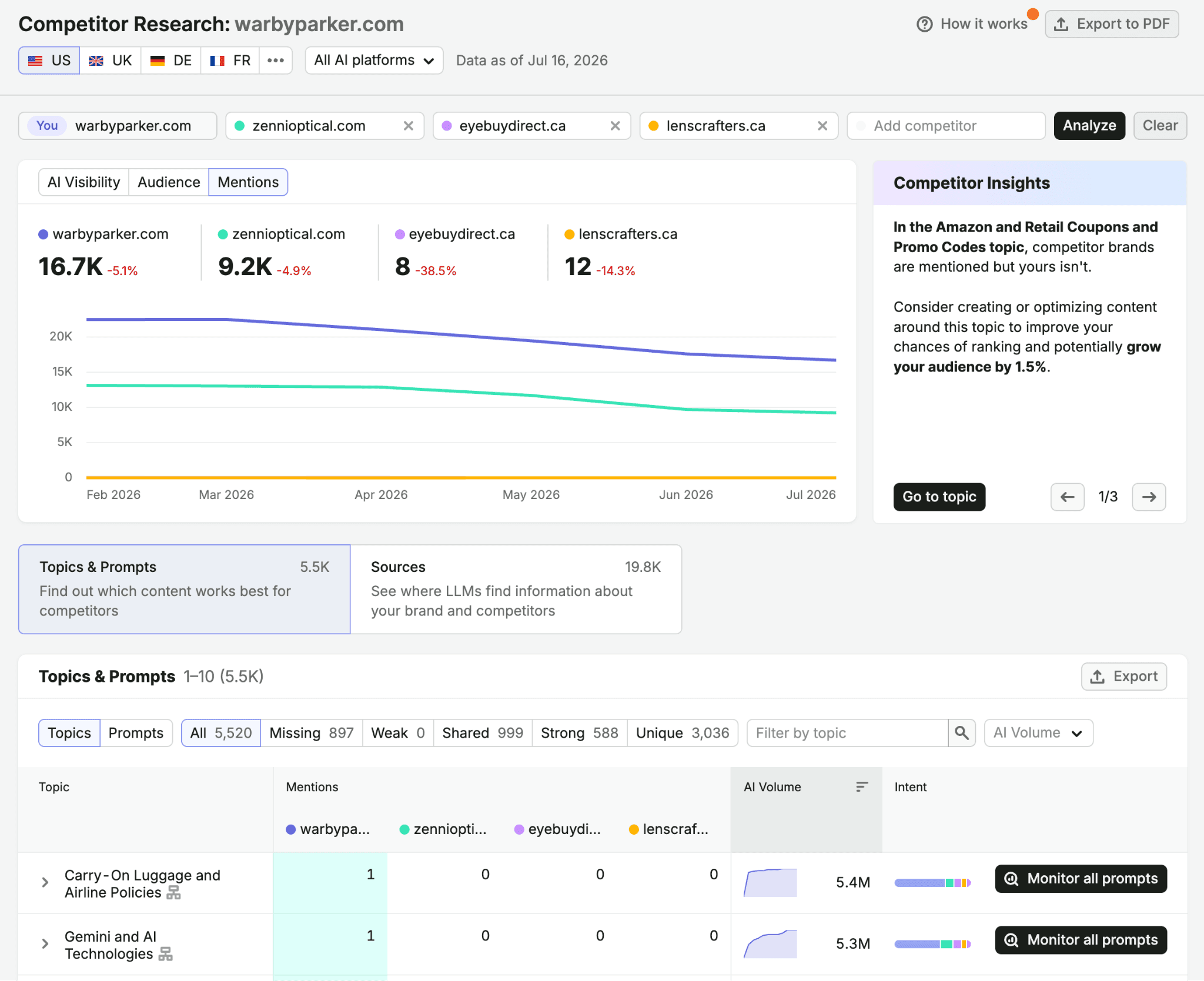
5Track the prompts, not just the keywords
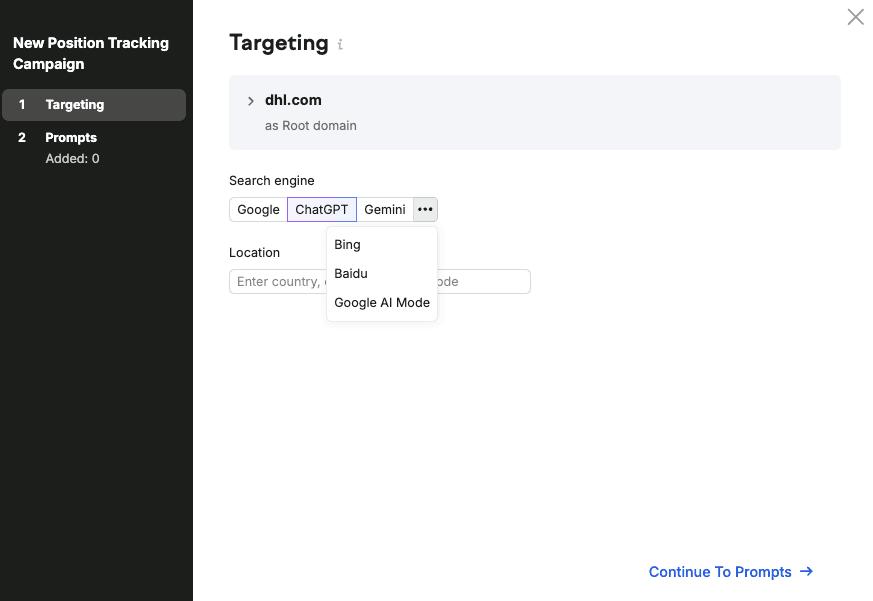
Add the head prompt and the most commercial sub-prompts to Prompt Tracking, which records visibility and position in ChatGPT and Google AI Mode daily. The standalone toolkit includes 25 tracked prompts. Then use Competitor Research to find prompts where competitors are named or cited and you are not.
6Remove technical blockers
Run the AI Search checks in Site Audit so that AI crawlers can reach the pages you just improved. A coverage map is useless if bots cannot fetch the content.
KPIs to report instead of a single citation count
| KPI | What it tells you | Where to get it |
|---|---|---|
| Sub-question coverage rate | Share of mapped sub-questions with a page or section that answers them | Your coverage map |
| Prompt visibility | How often and how high the brand appears for tracked prompts | Prompt Tracking |
| Competitor gap prompts | Prompts where rivals appear and you do not | Competitor Research |
| Cited pages | Which of your URLs AI answers use as sources | Visibility Overview |
| Share of voice and sentiment | How prominently and how positively the brand is described | Brand Performance |
| Organic rankings for sub-questions | Whether the cluster pages rank in classic search, which feeds retrieval | Position Tracking |
Report these together and trend them weekly. A single day’s citation count is a lagging and noisy signal; coverage and prompt visibility move first and explain why citations change.
Common mistakes
- Writing one giant page that touches every sub-question in a paragraph. Dedicated, clearly structured answers are easier to retrieve.
- Chasing zero-volume phrasing word for word. Fan-out wording varies run to run; cover the intent of the cluster rather than exact strings.
- Ignoring third-party pages. Reviews and comparisons on other sites answer evaluative sub-queries too. Being mentioned there is part of coverage.
- Reporting one snapshot. AI answers vary between runs and days. Use daily tracking and look at trends.
Which Semrush plan you need
The AI Visibility Toolkit costs $99 per month and, according to Semrush’s knowledge base, the standalone toolkit has no free trial. If you want keyword research, Site Audit and AI visibility together, Semrush One bundles the SEO Toolkit and AI Visibility Toolkit and includes more tracked prompts; Semrush offers a free 7-day trial on its main plans, so you can test the workflow above before paying. Check current terms at checkout, as plans change. Our Semrush One review compares the options.
Frequently asked questions
What is query fan-out in AI search?
It is the process where an AI search system splits one prompt into several sub-queries, searches them in parallel and combines the results into one answer. Google described it publicly when launching AI Mode in May 2025.
How many sub-queries does ChatGPT generate per prompt?
Peec AI’s analysis of more than 20 million ChatGPT fan-outs found about 2.3 to 2.8 per prompt on average between October 2025 and January 2026, with the queries roughly doubling in length.
Can I see the exact fan-out queries for my prompts?
Not reliably, because they are generated on the fly and vary between runs. You can approximate them by researching real prompts and the questions around them, then tracking visibility for those prompts over time.
How do I use Semrush for keyword research in AI search?
Start with Prompt Research to find real AI prompts, expand them with the Keyword Magic Tool’s question filter and Topic Research, map the sub-questions to pages, then monitor results with Prompt Tracking.
Does Semrush use AI?
Yes. Semrush uses AI across its products, and the AI Visibility Toolkit specifically measures how brands appear in AI answers on platforms such as ChatGPT and Google AI Mode.
Is the AI Visibility Toolkit free?
No. The standalone toolkit costs $99 per month and has no free trial, according to Semrush. Semrush’s main plans offer a 7-day free trial.
Map the questions behind your buyers’ prompts
Use Prompt Research and Prompt Tracking in the Semrush AI Visibility Toolkit to find and monitor the sub-questions that decide AI visibility.
Sponsored. Affiliate link: Dijipedya may earn a commission at no extra cost to you.
Get Dijipedya’s guides on AI search and visibility in your inbox.
Related guides on Dijipedya
Sources: Google, AI Mode announcement (May 2025); Search Engine Journal on Google’s R4T-Diffusion framework (24 September 2026); Peec AI, analysis of 20 million ChatGPT fan-out queries (February 2026); AirOps webinar recap with Chris Long of Nectiv (June 2026); Semrush Knowledge Base, AI Visibility Toolkit; Semrush news, AI visibility database expansion (May 2026); Semrush Keyword Magic Tool, UK database (19 October 2026).