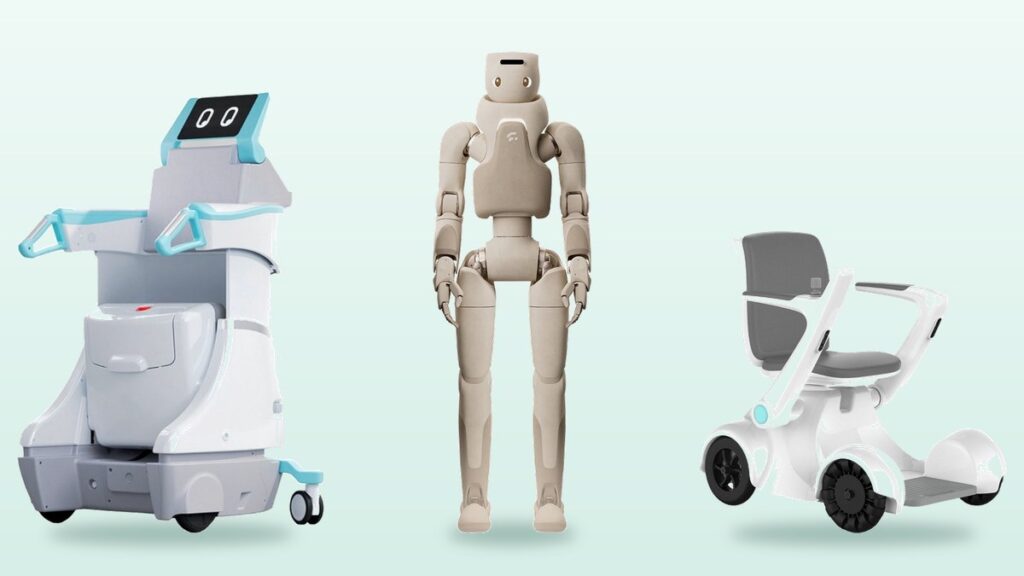
After a stroke, spinal cord injury or orthopaedic surgery, recovery depends on intensive, repetitive practice. Therapists cannot always deliver enough repetitions by hand. Rehabilitation robots and exoskeletons let patients train more often and more precisely, while recording every movement so progress can be measured.
This guide covers the Fourier rehabilitation range available through Robots Europa and the European rules clinics should know. It is part of our healthcare robots guide. It is general information, not clinical advice.
Contents
What rehabilitation robots do
Rehabilitation robots guide, assist or resist a patient’s movement. They can support weight, provide gravity compensation, give visual and audio feedback through games, and measure range of motion and strength. Exoskeletons support walking practice for people who cannot yet bear their own weight safely. The therapist sets goals and supervises; the robot delivers the repetitions and the data.
The Fourier rehabilitation range
1Upper limb: ArmMotus EMU and M2 Pro
ArmMotus EMU is a 3D back-drivable upper-limb robot with a cable-driven carbon-fibre parallel structure, offering range-of-motion work, gravity compensation, bilateral training and haptic, visual and audio feedback. ArmMotus M2 Pro is an all-in-one upper-limb system for motor control, cognitive training, strength, functional movement and activities of daily living.
2Lower limb: ExoMotus M4
ExoMotus M4 is a lower-limb exoskeleton with weight support for gait guidance, sit-to-stand transfer, verticalisation, walking and stepping with fall prevention.
3Wrist and ankle: WristMotus and AnkleMotus
WristMotus trains pronation and supination, deviation and flexion with accessories for daily-living tasks. AnkleMotus supports stretching, range of motion, motor control and strength for mobility recovery.
4Cycling, assessment and cloud
The CycleMotus series offers active and passive upper- and lower-limb cycling for patients at different stages. OTParvos Pro supports occupational therapy assessment, and InfinityNet connects devices to a cloud platform for tracking progress across a clinic.
Devices by body area
| Body area | Device | Typical use |
|---|---|---|
| Shoulder, elbow, arm | ArmMotus EMU | 3D upper-limb therapy with gravity compensation |
| Whole upper limb | ArmMotus M2 Pro | Motor, cognitive and ADL training |
| Wrist | WristMotus | Wrist and forearm movement |
| Ankle | AnkleMotus | Ankle mobility and strength |
| Walking | ExoMotus M4 | Gait training with weight support |
| Arms or legs | CycleMotus series | Active and passive cycling |
Robots Europa lists these as quote-only products for clinics, hospitals, rehabilitation centres and research. Final configuration, software, installation and training are defined in the quote.
Medical device rules in Europe
Rehabilitation robots and exoskeletons used for therapy are medical devices. In the EU they must carry CE marking under the Medical Device Regulation (EU) 2017/745, with documentation from the manufacturer or its authorised representative and registration in the EU’s device database as the regulation is phased in. Before buying, ask for the MDR certificate, the intended purpose and indications, and the clinical evidence. Patient data stored in the device or cloud is health data under GDPR.
How clinics evaluate rehab robots
1Start from your patient mix
Stroke, spinal cord injury, orthopaedics and paediatrics need different devices. Map current caseloads first.
2Check space, staff and throughput
Exoskeletons need room and trained staff; tabletop upper-limb devices fit smaller gyms.
3Ask about evidence and reimbursement
Clinical studies and national reimbursement rules affect whether a device pays back.
4Plan training and service
Therapist training, software updates and service response are part of the investment. Our warranty checklist helps frame the questions.
Referral note: When you request a quote from Robots Europa, mentioning Dijipedya and referral code 08AF5658 helps your enquiry be tracked correctly.
Frequently asked questions
What is a rehabilitation robot?
A device that guides, assists or resists a patient’s movement during therapy, while recording performance data.
Are exoskeletons medical devices in the EU?
Rehabilitation exoskeletons used in therapy are medical devices and must comply with the EU Medical Device Regulation.
Do rehab robots replace physiotherapists?
No. They increase the number of repetitions and provide data; therapists set goals and supervise.
Can patients use Fourier devices at home?
The products listed are aimed at clinics, hospitals and rehabilitation centres. Ask the supplier about any home-use versions.
Explore Fourier rehabilitation robots and request a quote for your clinic.
Affiliate link: we may earn a commission if you buy through it, at no extra cost to you.
More from Dijipedya English