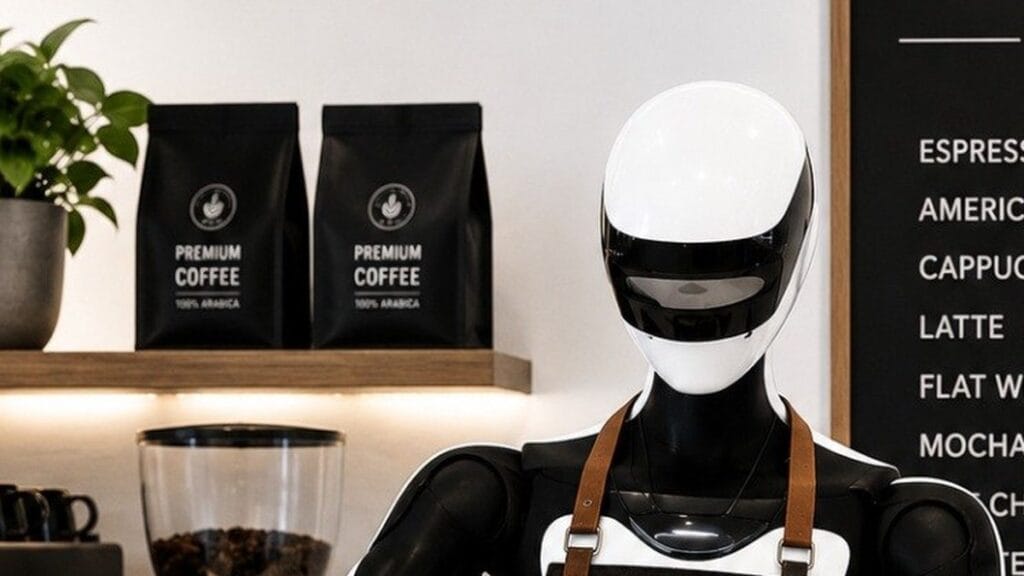
“Robot barista” covers very different products. A glass kiosk serving coffee at an airport at 3 am, a collaborative arm on a café counter and a humanoid robot using the café’s espresso machine all make coffee, but they suit different venues, budgets and goals. If you also serve cocktails, our robot bartender guide compares the bar-side options.
This guide compares the three approaches so you can decide which one fits your location.
Contents
Three ways to automate coffee
The first approach is the enclosed robotic kiosk: a robot arm and coffee equipment sealed in a transparent unit, designed to run with minimal staff. The second is a robot arm installed at an existing café counter. The third is a humanoid robot running barista software and using standard café equipment.
Robotic coffee kiosks
Robotic kiosks from brands such as Cafe X, Crown Digital and Rozum have operated in airports, offices, stations and hospitals. Orders come through a touchscreen or app, and the robot prepares drinks inside the enclosure. The strengths are long opening hours with minimal staffing and a small footprint; kiosks can go where a full café fit-out would not pay off.
The trade-offs: a fixed, limited menu, dependence on the vendor’s machine and service network, and staff are still needed to restock beans and milk and to clean. Guest interaction is mostly with a screen.
Robotic coffee kiosk brands compared
These are the automated café systems most often shortlisted. Prices are rarely published; the figures below are vendor list prices or third-party estimates checked on 11 October 2026, so treat them as a starting point for quotes.
| Brand | Format | Where it runs | Price information |
|---|---|---|---|
| Artly Barista Bot | Glass kiosk with a rail-mounted arm, latte art | US airports, offices, campuses | Estimated $68,000 to $88,000, or operator-as-a-service with revenue share |
| Crown Digital (Ella) | Fully enclosed kiosk | Changi Airport, Middle East airports, offices | On request |
| Rozum Café | Compact kiosk with a cobot arm | Transit hubs, malls | On request; third-party estimates around $75,000 to $100,000 |
| Cafe X | Enclosed kiosk | Scaled back in 2026 after closures | Not published |
| Oli Robotics | All-in-one coffee cell, about 1.6 m² | US offices and venues | $59,000 purchase or from $4,990 per month plus $5,000 installation |
| Ratio (Middleby) | Bean-to-cup machine, no visible robot | Corporate offices | On request |
For a humanoid robot barista instead of a kiosk, RoboBarista software runs on a compatible humanoid such as Unitree G1 Edu and uses your existing espresso machine.
How much does a robotic coffee kiosk cost?
Across the market, buying a fully automated coffee kiosk usually costs between $50,000 and $150,000 depending on menu, footprint and enclosure. Service and maintenance contracts are commonly quoted at $10,000 to $20,000 per unit per year. Leasing and robot-as-a-service models replace the upfront cost with a monthly fee, typically a few thousand dollars, often including service and software.
| Cost line | Typical range or question |
|---|---|
| Kiosk purchase | About $50,000 to $150,000 |
| Lease or subscription | About $2,500 to $5,000 per month, usually with service |
| Installation and commissioning | A few thousand dollars; water, drainage and power must be ready |
| Service contract | About $10,000 to $20,000 per year if not included |
| Site fees | Rent or revenue share at airports, stations and malls |
| Ingredients and cups | Beans, milk, syrups and cups, as in any café |
| Staff time | Daily restocking and cleaning, often 30 to 60 minutes |
Simple payback example
Assume a kiosk bought for $75,000, serving 200 drinks a day at a $2.00 margin per drink after ingredients. That is about $400 a day, or roughly $12,000 a month before rent, service and staff time. With $3,000 a month of running costs, the kiosk would pay back in around eight to nine months. At 60 drinks a day the same kiosk would take several years. Location and footfall decide whether a robotic coffee kiosk pays off, much more than the brand.
Automated café: popular search terms explained
| Search term | What people usually mean |
|---|---|
| Robotic coffee kiosk | A self-contained unit with a robot arm and coffee equipment |
| Automated café | A café where ordering and drink preparation run with little or no staff |
| Robot barista | Any robot that makes coffee: a kiosk, a counter arm or a humanoid |
| Coffee robot or AI barista | Often used for kiosks with app ordering and personalised drinks |
| Robot coffee shop | A full café concept built around a robot, see our guide to opening a robot café in Europe |
Robot arm in an existing café
Some suppliers sell collaborative robot arms that sit on a café counter and operate a traditional espresso machine. This keeps the café layout familiar and adds a visible robot, but the arm is fixed to one station and can only do what it was installed for.
Humanoid robot barista
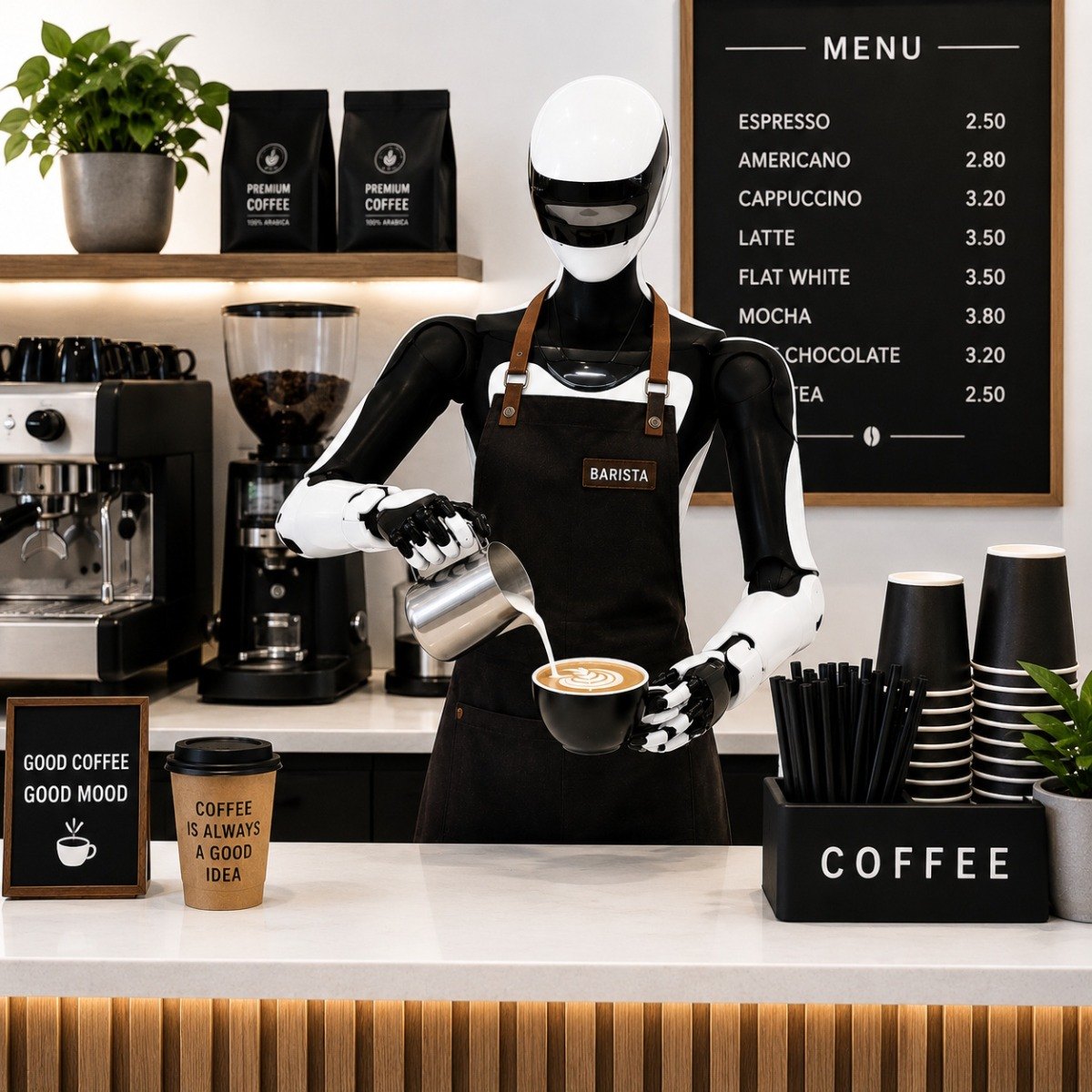
The third approach puts a humanoid behind the counter. RoboBarista is software for humanoids open to secondary development; it lets the robot use the venue’s existing espresso machine, grinder and milk equipment, runs drinks as repeatable profiles, checks every cup with its camera and stops when a hand enters its work area.
The advantage is flexibility: the same robot, for example a Unitree G1 EDU, can greet guests, promote products or, with the RoboTender software, serve drinks in the evening. The trade-offs are speed at peak times and battery planning. We go deeper in our humanoid robot barista guide.
Side-by-side comparison
| Criterion | Robotic kiosk | Arm at counter | Humanoid with RoboBarista |
|---|---|---|---|
| Coffee equipment | Built into the kiosk | Existing café machine | Existing café machine |
| Staffing | Minimal; restocking and cleaning | Barista team plus robot | Hybrid with staff |
| Opening hours | Can run long or around the clock | Café hours | Café hours, limited by battery |
| Guest experience | Screen-based, visual | Visible robot at the bar | Human-like, can talk and gesture |
| Flexibility | One job | One station | Several jobs with other software |
| Best for | Airports, stations, hospitals, offices | Existing cafés adding a feature | Flagships, hotel lobbies, brand experiences |
Which one fits your venue?
1High-traffic location with long hours
A robotic kiosk makes sense where coffee demand is constant and staffing a counter is hard, such as a station or hospital.
2Existing café wanting a visible robot
A counter arm adds automation without changing the café concept.
3Brand experience and flexibility
A humanoid with RoboBarista suits venues where the robot is part of the brand and can take on other roles. Our robot café guide covers concept and permits, and our buying guide covers VAT, CE and delivery.
Referral note: When you request a quote from Robots Europa, mentioning Dijipedya and referral code 08AF5658 helps your enquiry be tracked correctly.
Robot barista price in the US
Robot coffee kiosks and robot baristas are quoted per project. RobotsUSA offers a RoboSuite RoboBarista package on quote, built on a humanoid robot. The humanoid alone gives a price floor: the Unitree G1 Basic lists at USD 19,995 (19 October 2026), and the coffee machine, grinder, cup handling and software are added on top.
Store links are affiliate links; Dijipedya may earn a small commission if you buy, at no extra cost to you.
Frequently asked questions
How much does a robotic coffee kiosk cost?
Most fully automated coffee kiosks cost between $50,000 and $150,000 to buy, or a few thousand dollars per month on a lease or subscription. Service contracts, installation and site rent come on top.
How many drinks does a robotic coffee kiosk need to sell?
It depends on margin and running costs. As a rough guide, busy sites selling around 200 drinks a day can pay back a purchased kiosk within a year or two, while low-traffic sites take much longer.
What is an automated café?
A café where ordering, payment and drink preparation are handled by machines or robots, usually a robotic kiosk with app or touchscreen ordering and staff only for restocking and cleaning.
What is the difference between a robot barista and a coffee kiosk?
A kiosk is a self-contained unit with built-in equipment. A robot barista can also mean a robot, arm or humanoid, using a café’s own espresso machine.
Does a robotic kiosk need staff?
Yes, for restocking, cleaning and troubleshooting, even if orders run without staff.
Can a humanoid robot barista work all day?
It works between charges, so full-day service needs spare batteries or a shift plan.
How much does a robot barista cost?
Robot barista systems are quoted per project. In the US, the humanoid used in some packages, the Unitree G1, starts at USD 19,995 before the coffee equipment and software.
Explore RoboBarista and request a quote, with or without a compatible humanoid robot.
Affiliate link: we may earn a commission if you buy through it, at no extra cost to you.
More from Dijipedya English