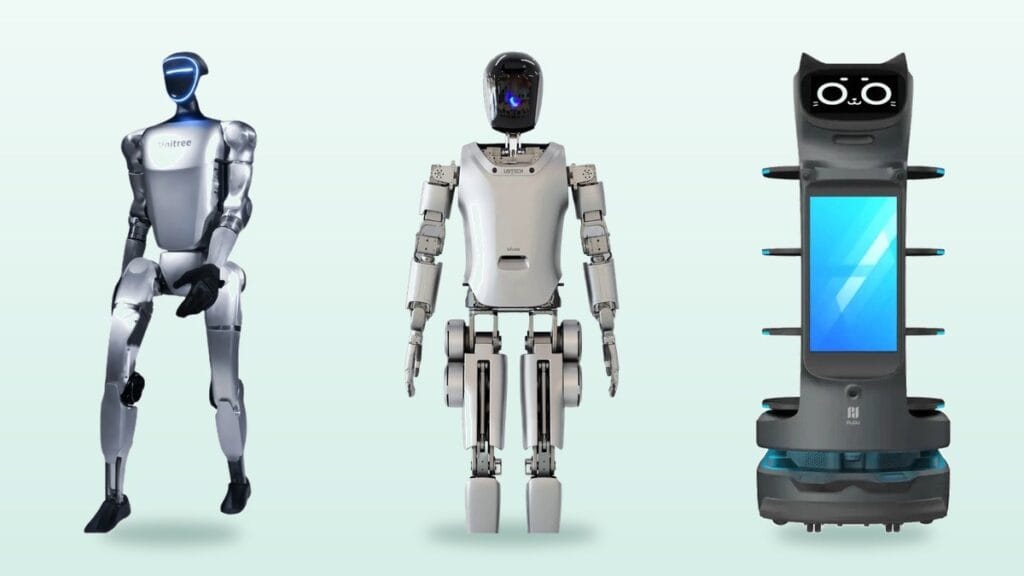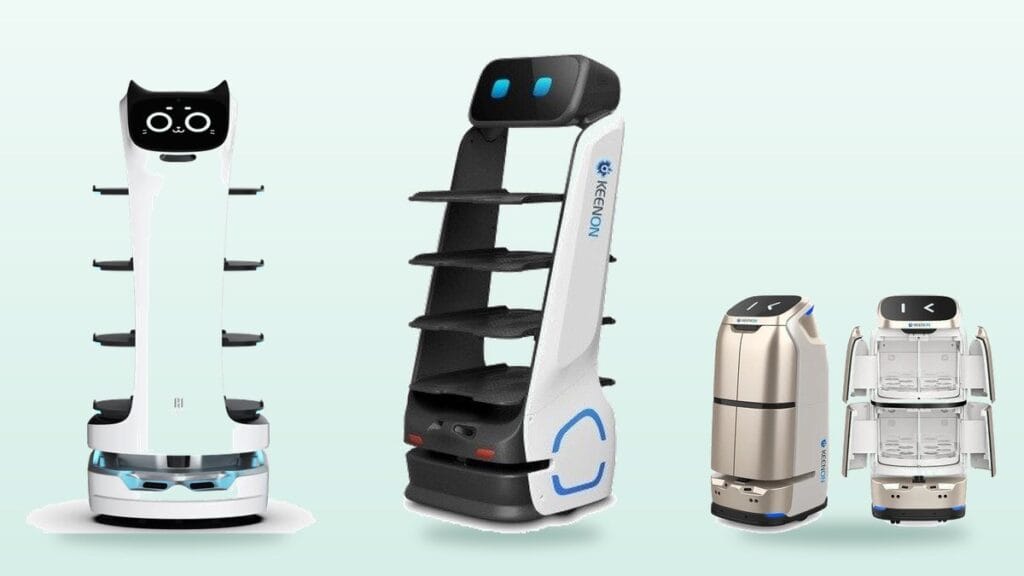
Across Europe, restaurants and hotels have struggled to fill front-of-house roles since the pandemic, and delivery robots have moved from novelty to practical tool. The cat-faced robot carrying plates between the kitchen and tables is PUDU BellaBot, the model most people picture when they hear “robot waiter”. But the category also includes hotel robots with lockable compartments, hospital delivery robots and retail robots with advertising screens.
This guide puts BellaBot at the centre and compares it with Keenon alternatives for restaurants, cafés, hotels and hospitals.
Contents
Robot waiter vs service robot: what is the difference?
A robot waiter is an open-tray delivery robot that runs food from the pass to the table. Staff load the trays, the robot drives to the table and guests take their plates. BellaBot, Keenon T9 and Keenon T8 are typical examples.
Service robot is a broader term. It covers hotel robots that deliver towels and room service in closed compartments, lockable hospital robots for samples and medication, and retail robots with advertising screens. Enclosed compartments, lift integration and access control are features a restaurant robot waiter usually lacks.
What PUDU BellaBot offers
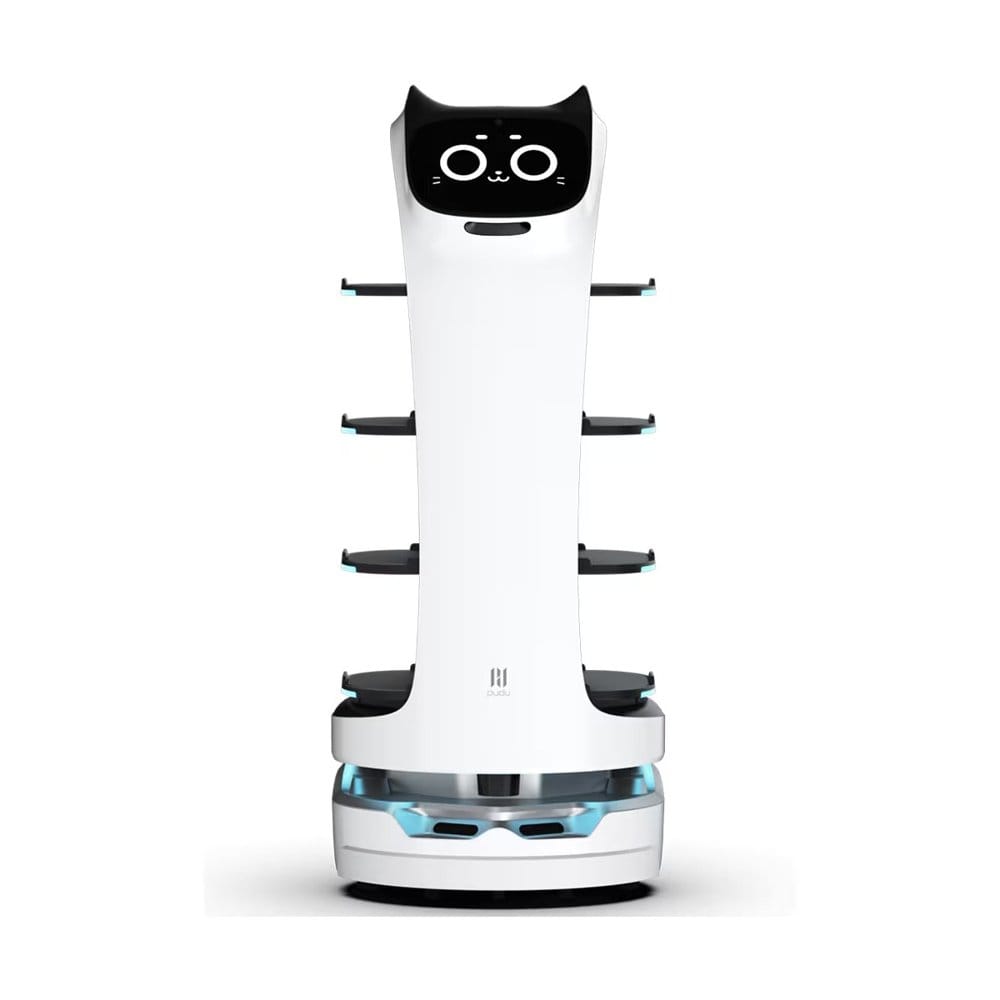
PUDU BellaBot measures about 56 x 54 x 129 cm and weighs 55 kg. It has four trays rated at 10 kg each, 40 kg in total, needs an aisle of roughly 70 cm and takes about 4.5 hours to charge.
It navigates with a combination of visual SLAM and laser SLAM and uses LiDAR plus RGBD depth cameras to spot obstacles, so it stops and reroutes around chair legs, bags on the floor or a child stepping into its path. The expressive cat face and voice interaction turn it into part of the experience, especially in family restaurants.
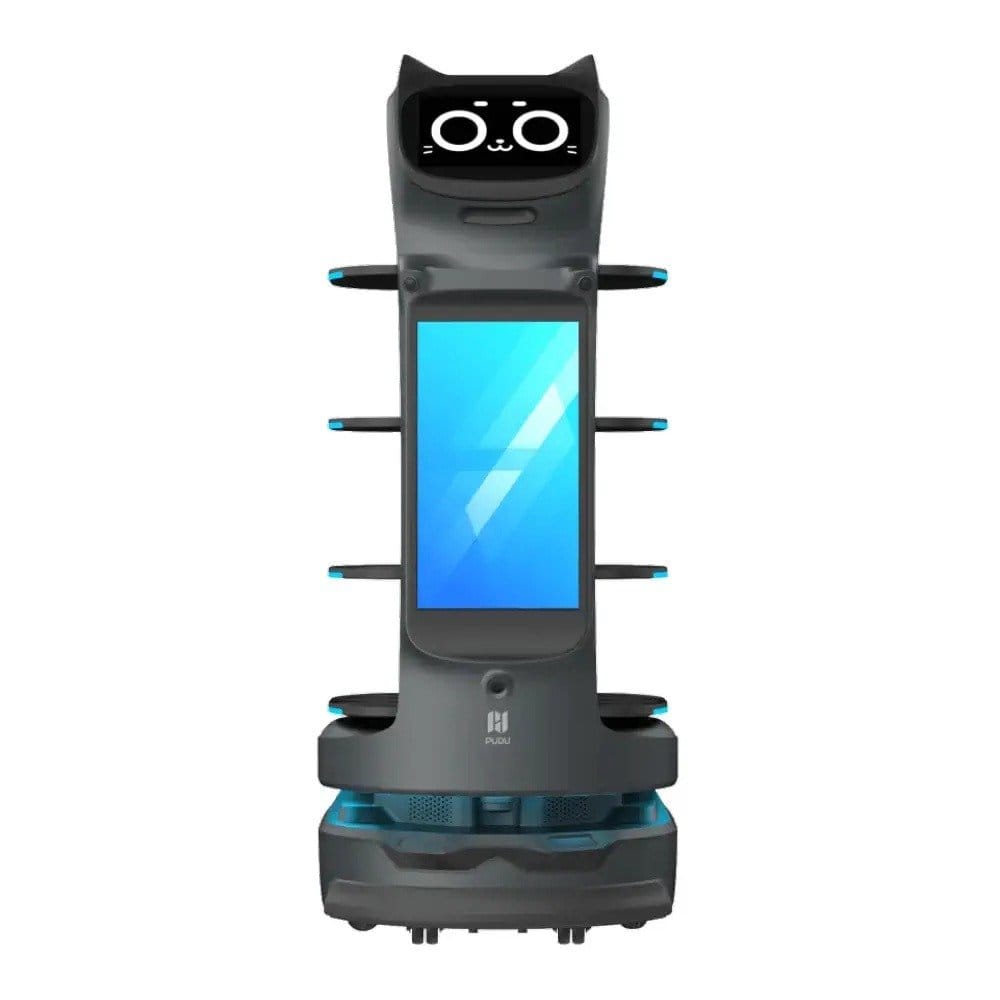
For venues that want to show promotions, BellaBot Pro adds an 18.5-inch advertising display beside its 10.1-inch touchscreen, runs for about 11 hours unloaded and fits through 65 cm aisles.
BellaBot alternatives
Keenon DINERBOT T9: long shifts
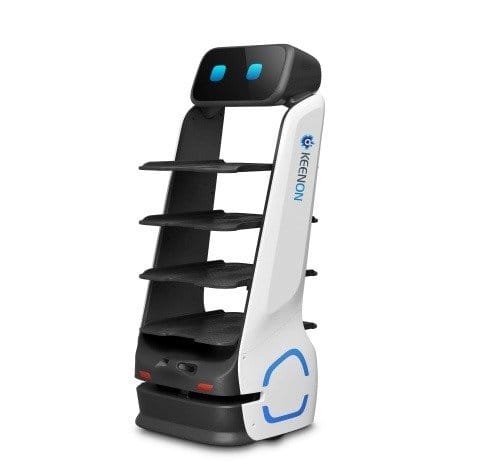
Keenon DINERBOT T9 is BellaBot’s closest rival. It carries 40 kg across four levels and fits through 70 cm aisles. Its advantage is battery life: 13 to 18 hours, enough for an all-day service without a midday charge. LiDAR and dual stereo vision detect both low and high obstacles, and it has an 11.6-inch screen.
Keenon DINERBOT T8: narrow cafés
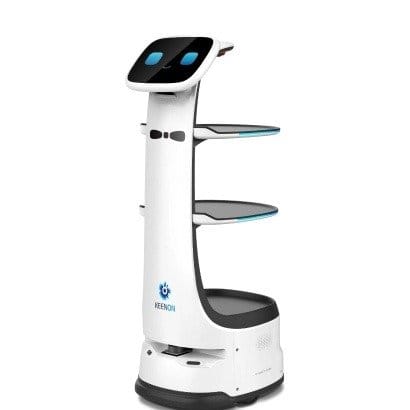
Keenon DINERBOT T8 is much slimmer at 38 x 47 x 111 cm. Passing through 55 cm aisles makes it a good fit for the tightly packed cafés and bistros common in European city centres. It carries 20 kg over three levels and runs 15 to 18 hours depending on the version.
Keenon BUTLERBOT W3: hotel room service
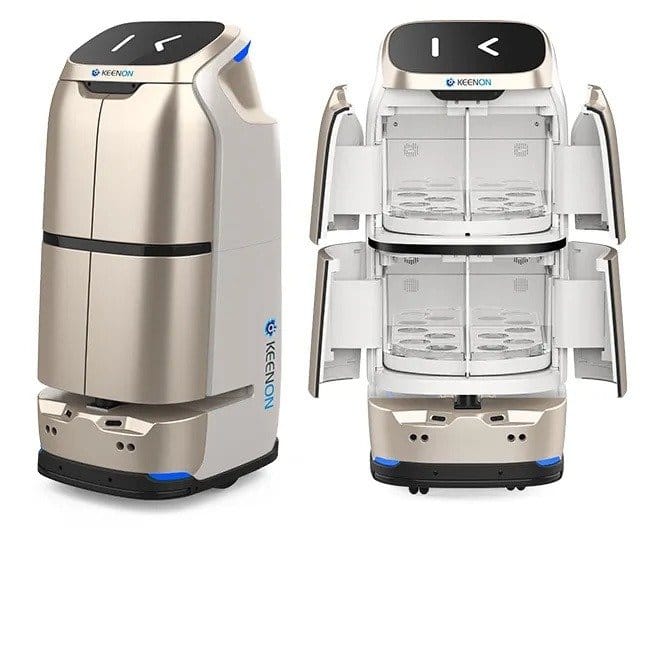
Keenon BUTLERBOT W3 uses closed compartments instead of open trays. It can be configured with 2, 3 or 4 compartments, 90 litres in total and a 20 kg payload, and runs 9 to 12 hours. Built for guest-specific deliveries between floors, it suits room service, towels and minibar restocking better than BellaBot.
Comparison table
| Feature | BellaBot | Keenon T9 | Keenon T8 | Keenon W3 |
|---|---|---|---|---|
| Type | Open-tray robot waiter | Open-tray robot waiter | Compact robot waiter | Enclosed service robot |
| Total payload | 40 kg | 40 kg | 20 kg | 20 kg, 90 L |
| Trays or compartments | 4 trays | 4 levels | 3 levels | 2 to 4 compartments |
| Narrowest aisle | About 70 cm | 70 cm | 55 cm | Not stated on product page |
| Runtime | Varies with use; about 11 h on Pro | 13 to 18 h | 15 to 18 h | 9 to 12 h |
| Charging time | About 4.5 h | 4 to 5 h | 4 to 4.5 h | 6.5 h |
| Best suited to | Family restaurants, themed venues | Busy restaurants, canteens | Cafés, narrow dining rooms | Hotels, serviced apartments |
Figures come from manufacturer and retailer pages. You can compare all models in the restaurant robot range and the hotel robot range.
Which robot for which venue?
1Large restaurants and staff canteens
BellaBot or T9. Choose BellaBot if guest engagement and brand experience matter most, T9 if long runtime is the priority.
2Small cafés with tight aisles
T8, whose 55 cm aisle width handles crowded layouts far better.
3Hotel room service
An enclosed robot such as W3. Open-tray robots work in hotel restaurants but are not suitable for deliveries to rooms.
4Hospitals and clinics
Hygiene and access control call for enclosed, lockable models. Open-tray robot waiters were not designed for clinical environments.
5Shopping centres and retail promotions
BellaBot Pro or Keenon T10, both designed to combine delivery with on-screen advertising.
What European operators should check
Start with the floor. Delivery robots handle thresholds, carpets and ramps only within limits; the T9, for example, climbs up to 5 degrees. A single step between the kitchen and the dining room will stop the robot. Measure your narrowest aisle and compare it with the model’s minimum width.
Check Wi-Fi coverage, multi-robot coordination, POS integration and the languages the robot speaks for your guests. For staff, frame the robot as help with carrying rather than a replacement; in many European countries, involving works councils or staff representatives early makes adoption smoother. Delivery, VAT and CE questions are covered in our guide to buying a robot in Europe.
Referral note: When you request a quote from Robots Europa, mentioning Dijipedya and referral code 08AF5658 helps your enquiry be tracked correctly.
Frequently asked questions
Is a robot waiter the same as a service robot?
A robot waiter is the restaurant subset of service robots. Service robots also include enclosed delivery robots for hotels and hospitals and promotional robots for retail.
How many plates can BellaBot carry?
It has four trays, each rated at up to 10 kg, for a total of 40 kg.
Does a robot waiter serve food to the table itself?
No. It brings the plates to the table and guests or staff lift them off the tray.
How wide do aisles need to be for a robot waiter?
About 70 cm for BellaBot and T9, and 55 cm for T8. Leaving more space at peak times means the robot stops less often.
Compare restaurant and service robots and request a quote for delivery in your country.
Affiliate link: we may earn a commission if you buy through it, at no extra cost to you.
More from Dijipedya English