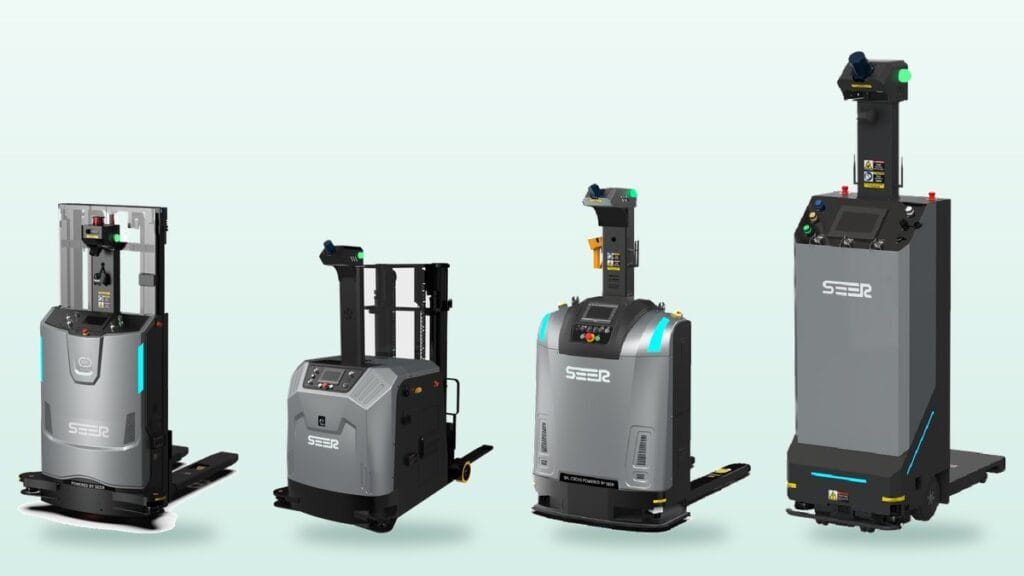
Forklift drivers are among the hardest roles to recruit in European logistics, and forklift traffic is one of the main sources of warehouse accidents. Autonomous forklifts tackle both problems by taking over the repetitive pallet moves, such as goods-in to storage, production line feeding and staging for dispatch, that make up much of a forklift driver’s day.
This guide explains the main types of autonomous forklift, compares SEER Robotics models available from Robots Europa and covers the European safety framework. It is part of our industrial and field robots guide.
Contents
What is an autonomous forklift?
An autonomous forklift is a forklift or pallet truck that navigates and handles pallets without a driver. Most use laser SLAM to build a map of the site, so no floor magnets or reflectors are needed, plus safety laser scanners, obstacle sensors and pallet-detection cameras. A fleet management system assigns tasks, and integration with your WMS or MES lets pallets move automatically when an order or production signal is created.
Autonomous forklifts sit between simple AMRs that carry carts or shelves and fixed conveyors. For a broader comparison with humanoids, see our humanoid vs AMR guide.
Types of autonomous forklifts
1Autonomous pallet trucks
Move pallets at floor level between docks, production and staging areas. The simplest and most common first step.
2Autonomous stackers
Lift pallets onto racking or stacks, typically for low to mid-height storage.
3Counterbalanced autonomous forklifts
Handle pallets without straddle legs, so they can pick from the floor, from closed-bottom pallets and from trucks, just like a conventional counterbalance forklift.
4Omnidirectional and narrow-aisle models
Move sideways or rotate in place to work in tight spaces or with long loads.
5Mobile bases
Low autonomous platforms that carry racks, carts or custom top modules under them.
SEER autonomous forklifts compared
| Model | Type | Max payload | Runtime | Positioning accuracy |
|---|---|---|---|---|
| SEER OneFork 300 (SOF-300EU) | Single-fork pallet truck | 300 kg | Up to 6 h | ±10 mm |
| SEER Omnidirectional Stack 1000 | Omnidirectional stacker | 1,000 kg | Up to 10 h | ±10 mm |
| SEER SlimStack 1500 (SSS-1500EU) | Stacker | 1,500 kg | Up to 10 h | ±10 mm |
| SEER SFL-CBD20 | Pallet truck | 2,000 kg | Up to 10 h | ±10 mm |
| SEER SFL-CPD20-Y | Counterbalanced forklift | 2,000 kg | Up to 8 h | ±10 mm |
| SEER SCB-2000EU | Counterbalance truck, EU model | 2,000 kg | Up to 12 h | ±10 mm |
| SEER AMB-300 | Mobile base | 300 kg | Up to 12 h | ±5 mm |
Values are manufacturer figures published on Robots Europa. Real runtime depends on load, route length, ramps and temperature.
The models in detail
Pallet trucks: OneFork 300 and SFL-CBD20
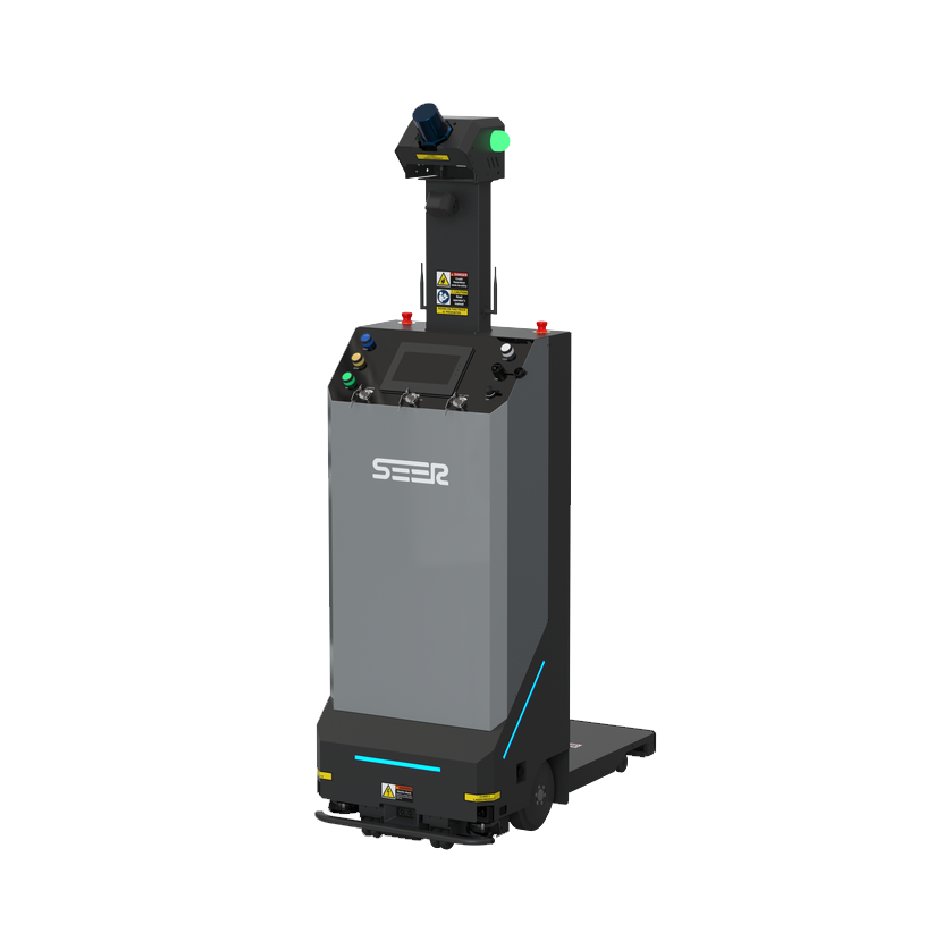
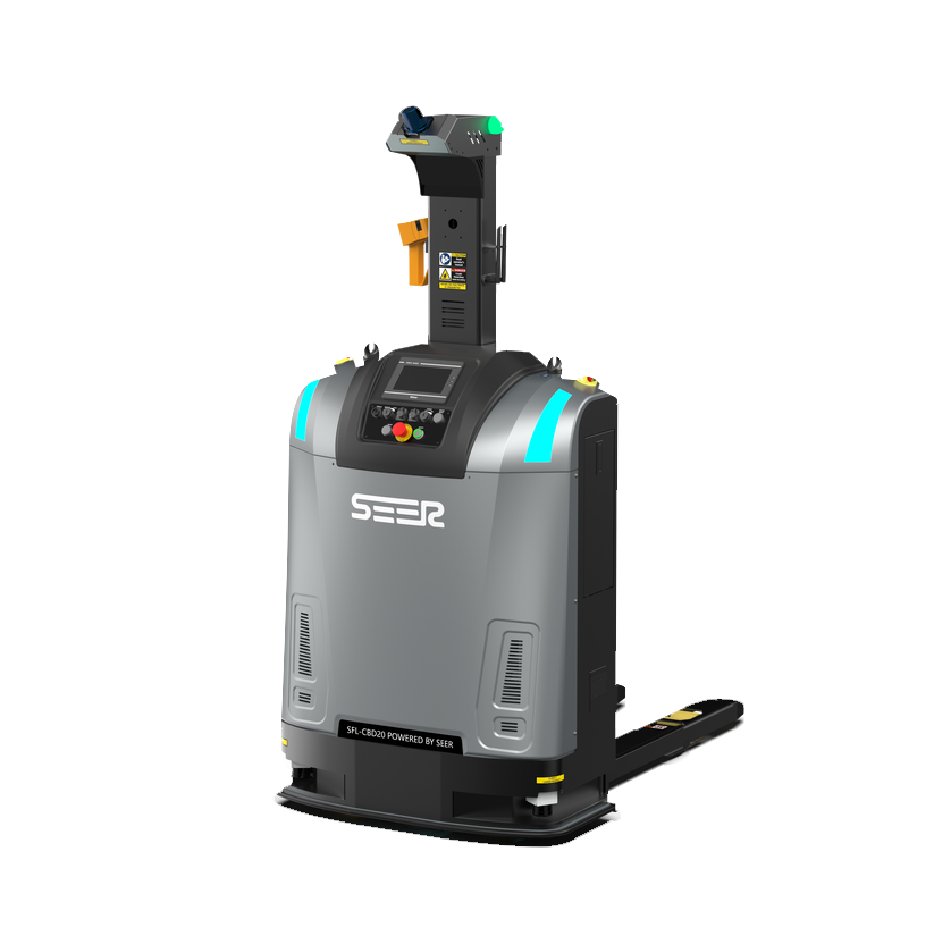
SEER OneFork 300 is a compact single-fork pallet truck for light loads up to 300 kg, travelling at up to 1.4 m/s. At the other end, SFL-CBD20 moves pallets up to 2,000 kg at up to 1.66 m/s and runs up to 10 hours on a 51.2 V battery. For heavier loads, a 3-ton version is also listed.
Stackers: SlimStack 1500 and Omnidirectional Stack 1000
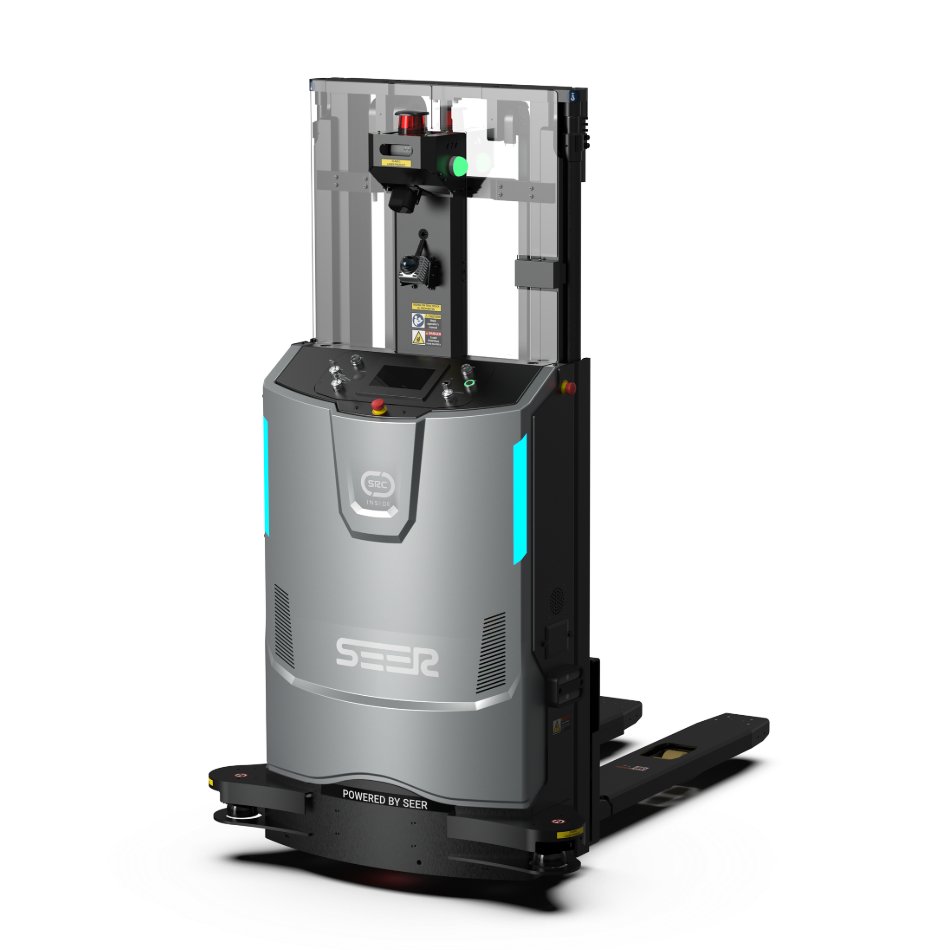
SEER SlimStack 1500 lifts up to 1,500 kg, runs up to 10 hours and positions pallets to ±10 mm, a common choice for putting pallets away into low racking. SEER Omnidirectional Stack 1000 handles 1,000 kg and can move in any direction, which helps in narrow aisles and with awkward pick-up positions.
Counterbalanced trucks: SFL-CPD20-Y and SCB-2000EU
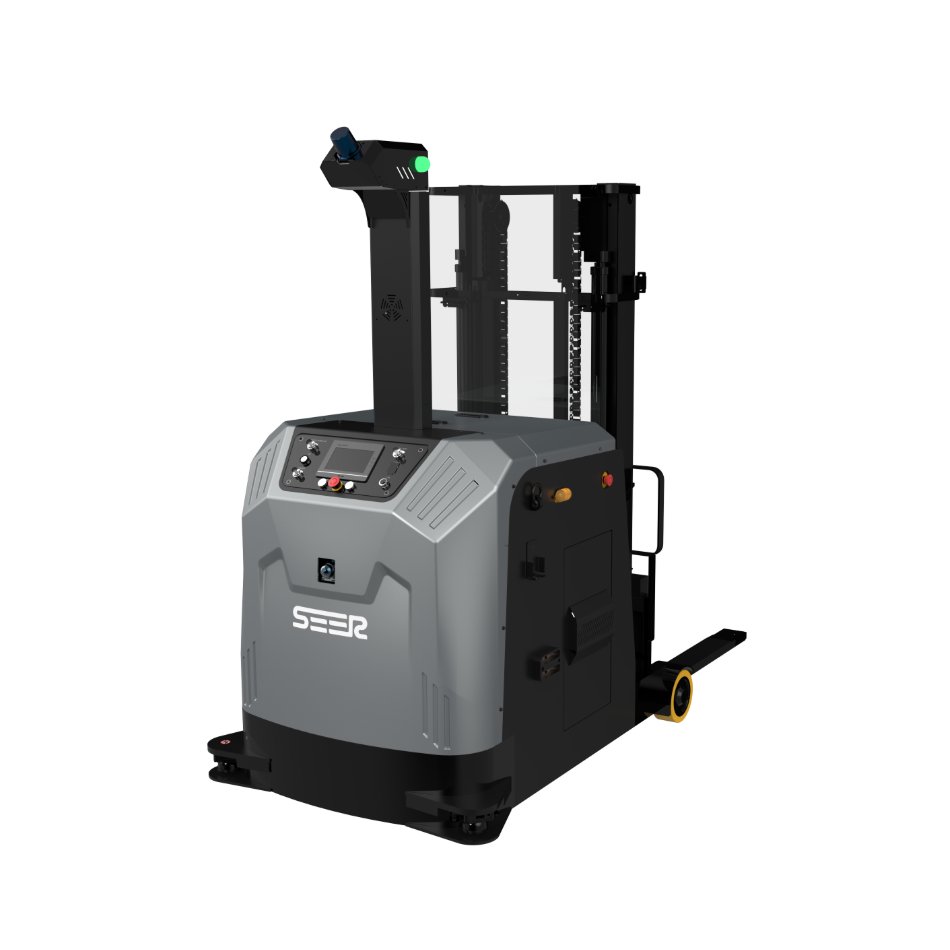
Counterbalanced autonomous forklifts can lift from the floor without straddle legs. SFL-CPD20-Y handles 2,000 kg with up to 8 hours of runtime, while the EU-model SCB-2000EU handles 2,000 kg with up to 12 hours from a 48 V, 315 Ah battery. A 3,000 kg EU model is available for heavier pallets.
Mobile base: AMB-300
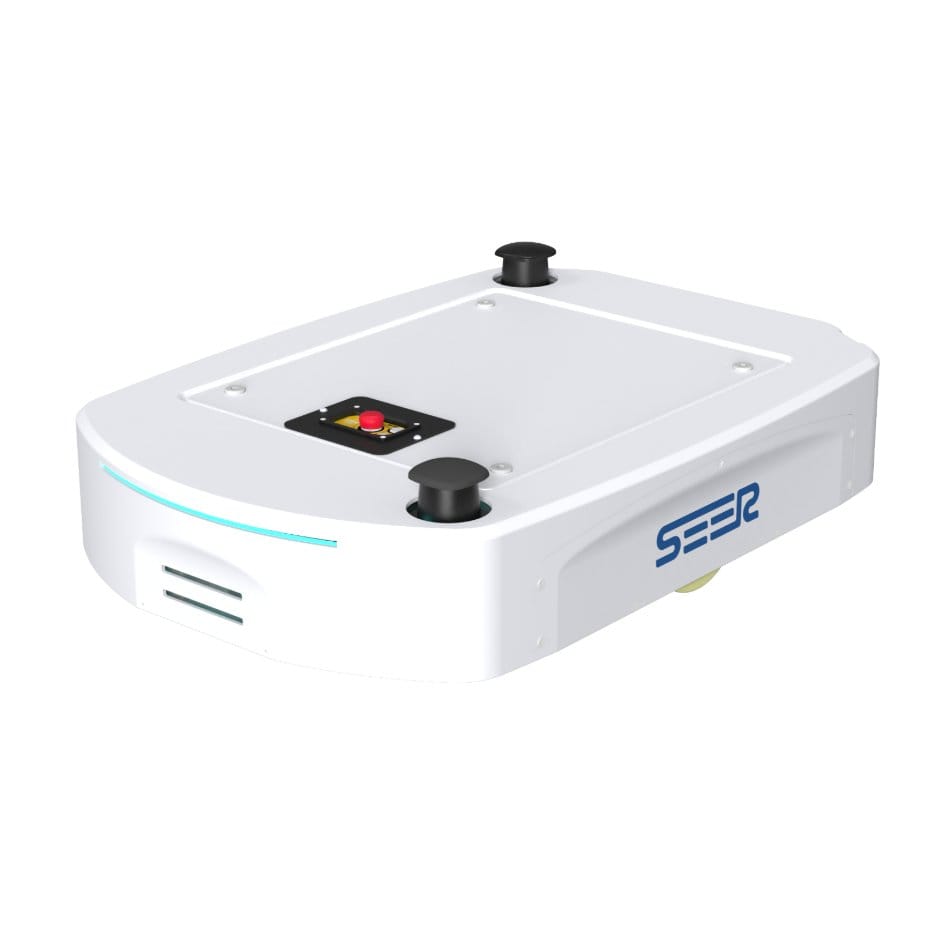
SEER AMB-300 is a low autonomous base carrying up to 300 kg for up to 12 hours with ±5 mm positioning, used under carts, racks and custom modules in production lines.
Is your warehouse ready?
1Repetitive, predictable routes
The best candidates are fixed A-to-B moves repeated many times per shift, such as production line feeding or goods-in to buffer storage.
2Pallet and floor quality
Consistent pallet types, typically Euro pallets, and reasonably flat, clean floors make automation much easier. Damaged pallets and steep ramps cause most stoppages.
3Mixed traffic
Plan how autonomous and manual forklifts and pedestrians will share aisles, including crossing points and speed zones.
4Systems integration
Decide whether tasks come from a WMS, an MES, buttons at stations or a fleet manager, and who owns that integration.
Safety and standards in Europe
In Europe, driverless industrial trucks are generally assessed against ISO 3691-4, which covers safety requirements for driverless trucks and their systems, together with the machinery rules behind CE marking. The EU Machinery Regulation (EU) 2023/1230 replaces the Machinery Directive from 20 January 2027. You remain responsible for the site risk assessment, including zones, speeds and pedestrian routes.
VAT, CE and delivery are covered in our guide to buying a robot in Europe. For the dock itself, see our truck unloading guide; for end-of-line stacking, our palletizing robot guide.
Referral note: When you request a quote from Robots Europa, mentioning Dijipedya and referral code 08AF5658 helps your enquiry be tracked correctly.
Frequently asked questions
Do autonomous forklifts need floor markers?
Most modern models, including SEER’s, use laser SLAM natural navigation, so magnets or reflectors are usually not required.
Can autonomous forklifts work alongside people?
Yes, with safety scanners, speed zones and a site risk assessment. Mixed traffic needs careful layout planning.
Which autonomous forklift should I start with?
For most sites, an autonomous pallet truck on a single repetitive route is the simplest first project.
Which safety standard applies to autonomous forklifts in Europe?
ISO 3691-4 is the key standard for driverless industrial trucks, alongside the EU machinery rules.
Compare autonomous forklifts and pallet trucks and request a quote for your site in Europe.
Affiliate link: we may earn a commission if you buy through it, at no extra cost to you.
More from Dijipedya English