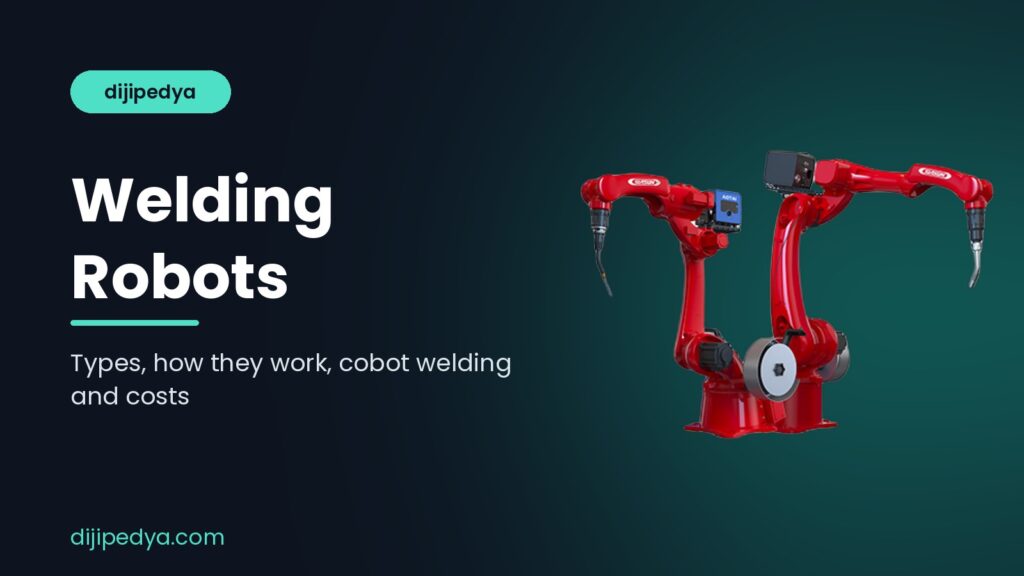
Welding was the first big job for industrial robots and is still one of the most common. Robots make the same weld the same way every time, keep workers away from fumes and arc light, and can run through the night. In 2026 robot welding is no longer limited to car plants: collaborative welding robots and teach-free systems now make sense for small fabrication shops too.
This guide explains the main types of welding robots, how a robot welding cell works, when a cobot welder is the better choice and what a project costs. Product prices are Robots store list prices checked on 16 October 2026; most welding systems are sold on quote.
Contents
Types of welding robots
1Arc welding (MIG/MAG, TIG)
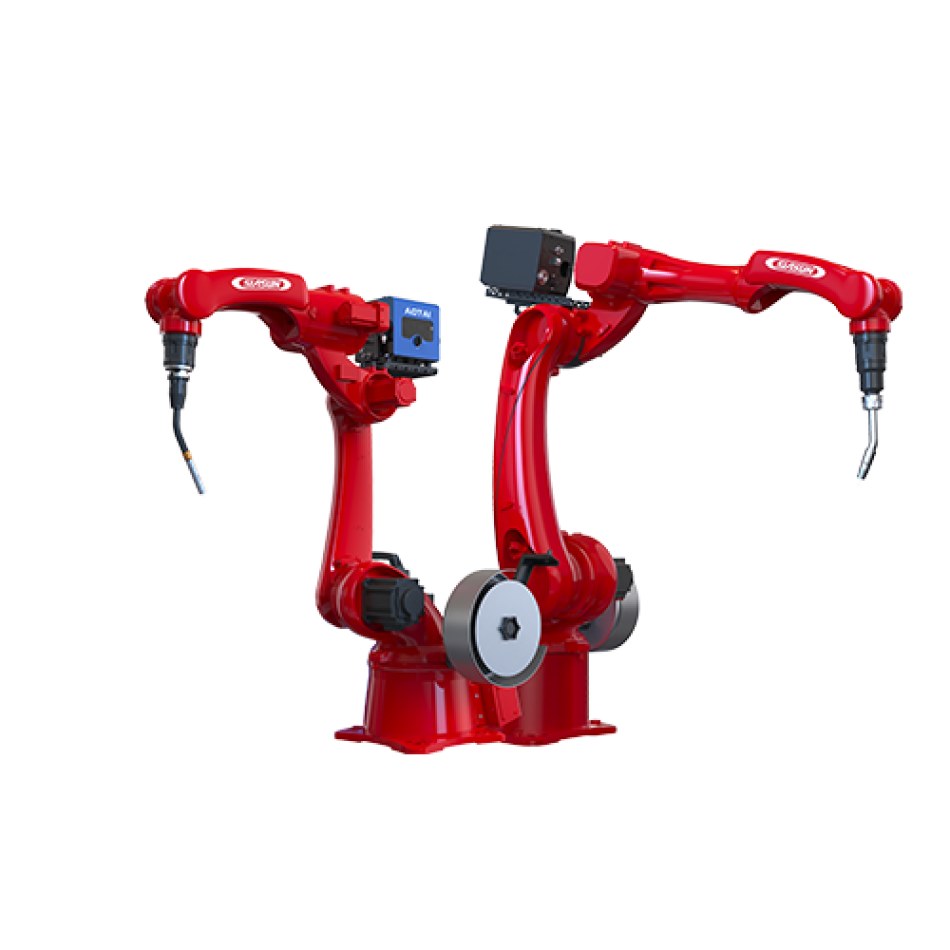
A six-axis arm carries a welding torch along a seam while a power source and wire feeder supply the arc. This is the most common type in fabrication, agricultural machinery, furniture and car parts.
2Spot welding
A heavy robot carries a spot welding gun that clamps and fuses sheet metal at points. Typical in car body shops.
3Laser welding
A laser head makes fast, narrow, low-distortion welds. Used for battery parts, thin sheet and high-precision components.
4Collaborative welding robots
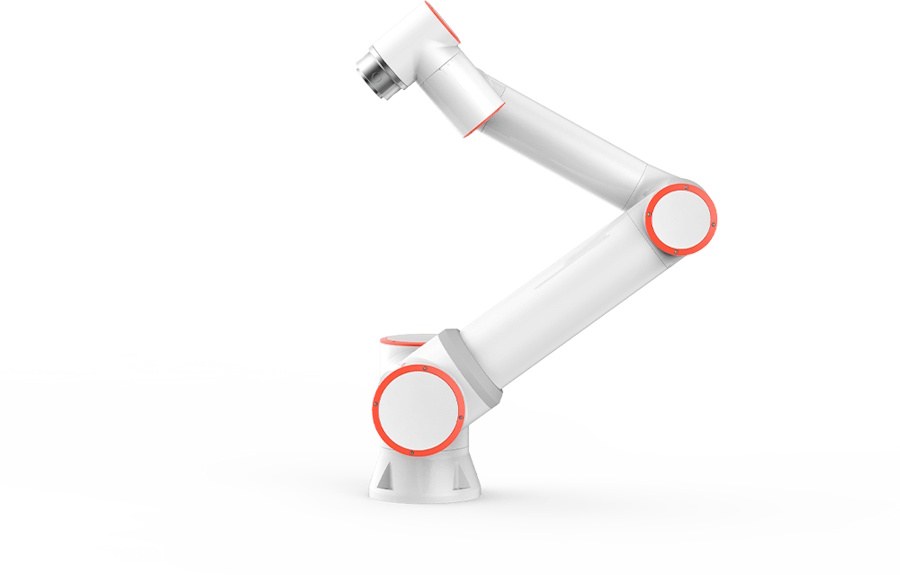
A cobot with a welding torch, programmed by hand guiding. Designed for small batches and shops without robot programmers.
How a robot welding cell works
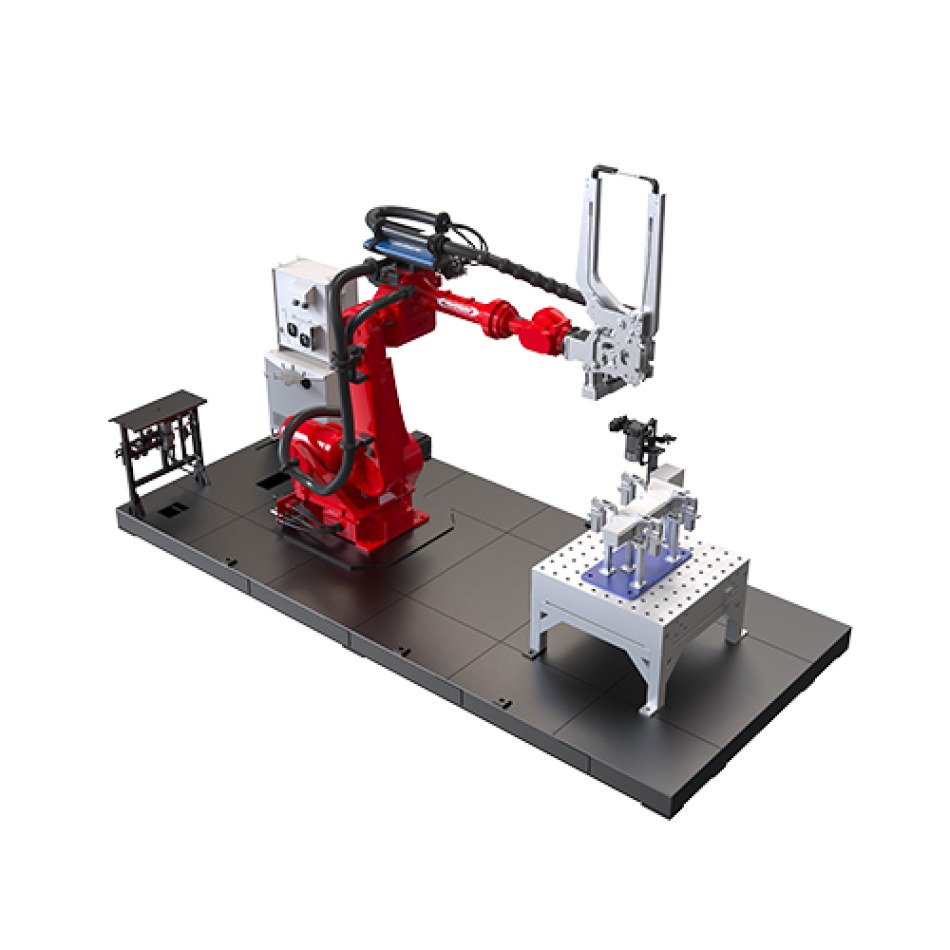
- Robot arm: usually six axes, with the torch cable routed through or along the arm.
- Welding power source and wire feeder: integrated with the robot controller so the program sets current, voltage and wire speed for each seam.
- Positioner: a turntable or tilting table that rotates the part so the robot welds in the best position.
- Fixtures and clamps: hold parts in the same place each time. Good fixtures are the single biggest factor in weld quality.
- Seam finding and tracking: touch sensing, laser or camera systems correct for small part variations.
- Torch cleaning station: cleans the nozzle and trims the wire automatically.
- Safety and fume extraction: fences or screens against arc light and spatter, plus extraction.
Cobot welding for small shops
A cobot welder pairs a collaborative arm with a standard welding power source. The welder moves the torch by hand to the start and end points, sets parameters on a tablet and presses start. Changeover between jobs can take minutes, which suits shops that weld batches of 10 to 500 parts rather than millions.
Cobot welders are slower than industrial welding cells and usually need screens for arc light, but they cost far less and need little programming skill. Lightweight welding cobots such as the Fairino FR3 welding version are built for this use. For cobot basics, see best cobots for small manufacturers.
Teach-free and vision-guided welding
The newest systems scan the part with a 3D camera, find the seams automatically and generate the robot path, so no one has to teach points. This removes the main barrier for high-mix, low-volume work such as steel structures and ship sections. SIASUN teach-free welding robot (on quote) is an example.
How much does a welding robot cost?
| System | Typical price range | Best for |
|---|---|---|
| Cobot welding package | €25,000 to €60,000 | Small shops, small batches |
| Industrial arc welding cell | €80,000 to €250,000 | Medium to high volume production |
| Spot welding line | €150,000 to several million | Automotive body shops |
| Laser welding cell | €150,000 to €500,000+ | Battery, precision, thin sheet |
These are typical market ranges; the final price depends on part size, positioners, fixtures and safety. Payback usually comes from higher arc-on time, less rework and the ability to run extra shifts. Our commercial robot costs guide shows how to calculate it.
Request a quote for welding robots and systems in your region.
Product links go to Robots stores (Europe, USA and other regions) through our partner link. If you buy through them, Dijipedya may earn a commission at no extra cost to you.
Welding robots and systems to compare
| System | Type | Price |
|---|---|---|
| Fairino FR3 welding cobot | Cobot welding | On quote |
| SIASUN arc welding solution | Arc welding cell | On quote |
| SIASUN spot welding solution | Spot welding | On quote |
| SIASUN laser welding solution | Laser welding | On quote |
| SIASUN teach-free welding robot | Vision-guided welding | On quote |
| SIASUN thin plate welding system | Sheet metal | On quote |
| FANUC, ABB, KUKA, Yaskawa | Industrial welding robots | On quote; see big-brand alternatives |
Before you invest
- Start with parts that repeat and have consistent fit-up. Poor fit-up is the most common reason robot welds fail.
- Plan fixtures early; they matter as much as the robot.
- Check which welding power sources the robot supports.
- Include fume extraction, arc screens and a risk assessment in the budget.
- Train at least one welder to run and adjust the robot.
- Ask for a trial weld on your own parts before ordering.
Frequently asked questions
What is a welding robot?
A welding robot is a programmable robot arm that carries a welding torch, spot gun or laser head and makes welds automatically, usually together with a positioner, fixtures and safety equipment.
How much does a welding robot cost?
Cobot welding packages typically cost €25,000 to €60,000, while industrial arc welding cells cost about €80,000 to €250,000 depending on part size and automation.
Can a cobot weld?
Yes. Collaborative robots can be fitted with MIG/MAG or TIG torches and programmed by hand guiding, which suits small batches in smaller shops.
What types of welding can robots do?
Robots perform arc welding (MIG/MAG, TIG), spot welding, laser welding, plasma and friction stir welding.
Do welding robots replace welders?
They change the job rather than remove it. Skilled welders set up, program and check robot welds and handle complex or one-off work.
New robots, price changes and buying guides, once a week in your inbox.
Related guides on Dijipedya
Sources: International Federation of Robotics, World Robotics (welding share of installations); SIASUN and Fairino product pages; Robots Europa product catalogue (16 October 2026). Price ranges are typical market estimates, not manufacturer list prices.